Medical emergency in Korea situations can feel overwhelming, especially if you do not speak Korean or are unfamiliar with the healthcare system.
Many foreigners living in or visiting South Korea worry about questions such as:
- 🚑 What emergency number should I call?
- 💸 Is the ambulance free?
- 📞 Can I call 119 if I don’t speak Korean?
- 🩺 What is the 1339 medical hotline?
- 🏥 How much does an emergency room visit cost?
The good news is that South Korea has a fast, reliable, and well-organized emergency medical system that supports both residents and visitors.
Whether you are a tourist, international student, digital nomad, or long-term resident, knowing what to do during a medical emergency can save valuable time and reduce unnecessary stress.
💡 Understanding how emergency services work before you need them can help you respond more calmly and confidently when every minute matters.
🚨 Emergency Numbers in Korea
There are two emergency numbers every foreigner in Korea should know:
| Number | Purpose |
|---|---|
| 🚑 119 | Ambulance, fire, and medical emergencies |
| 🚔 112 | Police emergencies |
For any serious health-related emergency, call 119 immediately.
Examples include:
- ❤️ Severe chest pain
- 😮💨 Difficulty breathing
- 🩸 Heavy bleeding
- 🩹 Serious injuries
- 😵 Loss of consciousness
- 🧠 Suspected stroke
- 🤧 Severe allergic reactions
- 🚗 Major accidents
💡 If someone’s life may be at risk, do not wait—call 119 right away.
🚑 Is the Ambulance Free in Korea?
Yes. Official 119 ambulances are free of charge in South Korea.
This applies to:
- Korean citizens
- Foreign residents
- International students
- Tourists
✅ What Is Included?
| Service | Included |
|---|---|
| Emergency dispatch | ✅ |
| Ambulance transportation | ✅ |
| Basic emergency care during transport | ✅ |
| Transfer to an appropriate hospital | ✅ |
Many foreigners are surprised by this because ambulance rides can be extremely expensive in some countries.
In Korea, however, public 119 ambulance services are provided free of charge, regardless of nationality or visa status.
⚠️ Important: The ambulance ride is free, but hospital treatment, emergency room fees, tests, and medication are billed separately.lances are funded by the government and local fire departments.
📞 How to Call 119 as a Foreigner
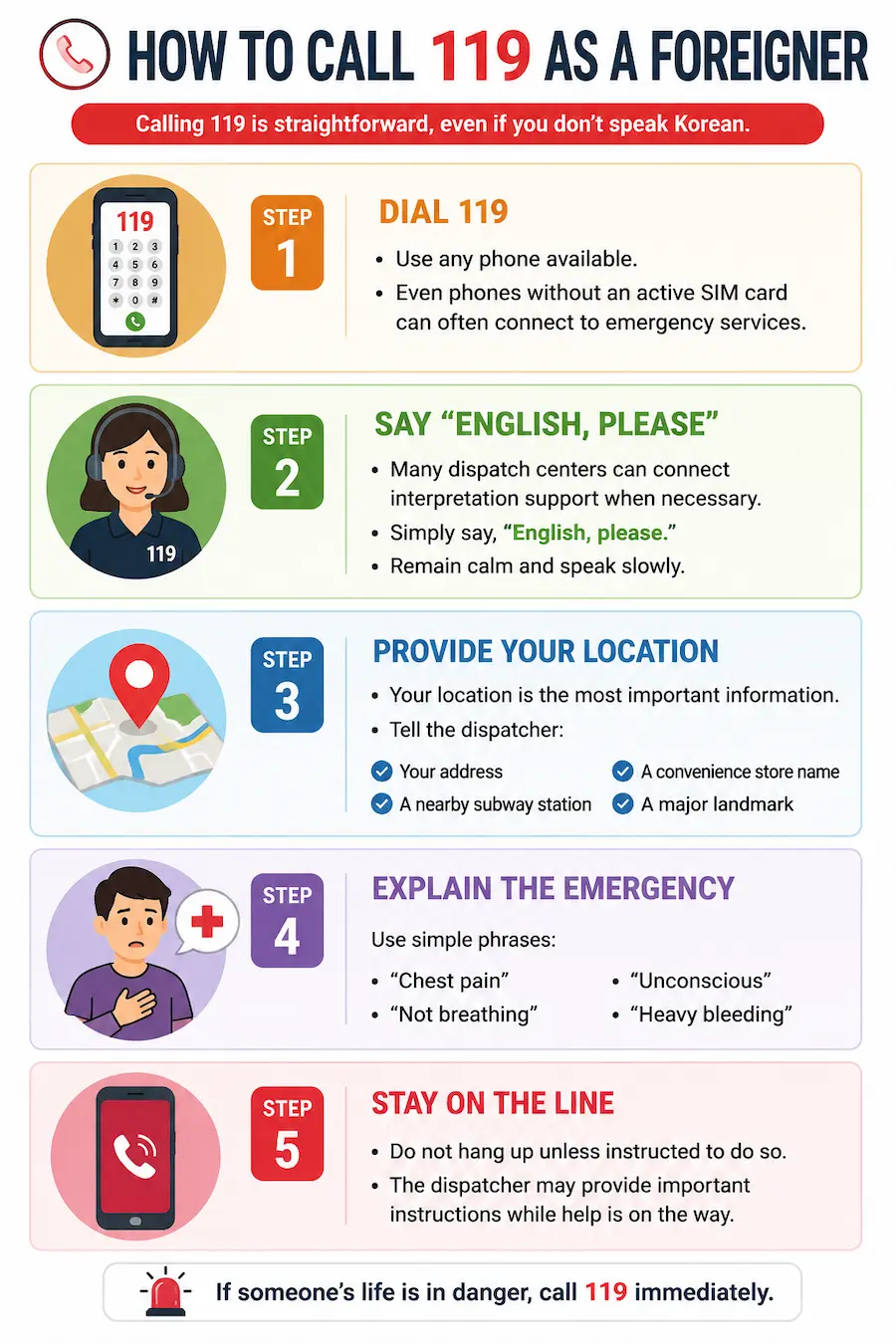
💡 Calling 119 is straightforward, even if you do not speak Korean. Stay calm, provide your location clearly, and remain on the line until help arrives.
📍 How to Explain Your Location in Korea
One of the biggest challenges during an emergency is telling the dispatcher exactly where you are.
Fortunately, there are several easy ways to share your location in Korea.
| 📍 Option | Example | Why It Helps |
|---|---|---|
| 🚇 Subway Station | “Hongdae Station Exit 9” | Emergency responders can quickly identify your location. |
| 🏪 Convenience Store | “GS25 near Gangnam Station” | Convenience stores are everywhere and easy to find. |
| 🏢 Major Landmark | A hotel, department store, or famous building | Helps responders locate you faster. |
| 📱 Smartphone Map | Show your location on Naver Map or KakaoMap | Provides the most accurate information if you’re unsure of your address. |
🚇 Use a Subway Station
If you’re near public transportation, tell the dispatcher:
- “Hongdae Station Exit 9”
- “Gangnam Station Exit 11”
In many cases, this information is enough for emergency responders to locate you quickly.
🏪 Use a Convenience Store
Convenience stores are everywhere in Korea and can be useful reference points.
Look for:
- CU
- GS25
- 7-Eleven
- Emart24
If possible, tell the dispatcher the store name or hand your phone to an employee who may be able to assist.
💡 Knowing the nearest subway station or convenience store can save valuable time during an emergency, especially if you do not know your exact address.
🗣️ Emergency Korean Phrases Every Foreigner Should Know
In an emergency, even a few simple Korean phrases can help first responders understand the situation more quickly.
| Korean (Romanization) | Meaning |
|---|---|
| 😵 Ui-sik Eop-seo-yo (의식 없어요) | The person is unconscious. |
| ❤️ Ga-seum A-pa-yo (가슴 아파요) | I have chest pain. |
| 🩸 Pi-ga Mani Na-yo (피가 많이 나요) | There is heavy bleeding. |
| 😮💨 Sum Mot Swi-eo-yo (숨 못 쉬어요) | I cannot breathe properly. |
| 🤰 Yang-su Teo-jyeo-sseo-yo (양수 터졌어요) | My water broke. |
| 😵💫 Eojireo-wo-yo (어지러워요) | I feel dizzy. |
| 🤒 Yeori Na-yo (열이 나요) | I have a fever. |
| 🤢 Tó-hae-yo (토해요) | I am vomiting. |
| 💊 Allergy-ga Isseo-yo (알레르기가 있어요) | I have an allergy. |
| 🏥 Byeong-won Gaya Hae-yo (병원 가야 해요) | I need to go to the hospital. |
| 📞 Yeong-eo Hae Juseyo (영어 해 주세요) | Please speak English. |
💡 Consider saving these phrases on your phone or taking a screenshot before traveling in Korea. During an emergency, a few simple words can save valuable time.
🌙 What Is the 1339 Medical Hotline?
Not every medical problem requires an ambulance or an emergency room visit.
If you need medical advice but are unsure whether your situation is an emergency, call:
📞 1339
The 1339 Medical Hotline operates 24 hours a day and provides medical information and guidance throughout South Korea.
It is especially helpful for foreigners who need assistance outside normal clinic hours.
💡 How Can 1339 Help?
| Service | How It Helps |
|---|---|
| 🏥 Find Open Hospitals | Locate hospitals and emergency rooms that are currently open. |
| 💊 Find Late-Night Pharmacies | Search for nearby pharmacies after regular business hours. |
| 🩺 Medical Advice | Get guidance on whether your symptoms require emergency care. |
| 🌏 Language Assistance | Receive help communicating with medical staff when language is a barrier. |
📌 When Should You Call 1339?
Call 1339 if you:
✔️ Need a hospital late at night
✔️ Are unsure whether you should visit the emergency room
✔️ Need to find an open pharmacy
✔️ Need basic medical guidance or information
✔️ Need help navigating the Korean healthcare system
💡 Think of 1339 as a medical information hotline, while 119 is for life-threatening emergencies that require immediate assistance.
🏥 What Happens Inside a Korean Emergency Room?
Korean emergency rooms do not operate on a first-come, first-served basis.
Instead, patients are treated according to the severity of their condition, a process known as triage.
| Step | What Happens |
|---|---|
| 🩺 Initial Assessment | A nurse checks your vital signs and evaluates the urgency of your condition. |
| 📝 Registration | You may be asked for your passport or ARC, but treatment comes first in serious emergencies. |
| 🔬 Diagnostic Tests | Doctors may order blood tests, X-rays, CT scans, ECGs, or other tests if needed. |
| 💊 Treatment | Depending on the results, you may receive medication, observation, admission, or specialist care. |
💡 Patients with life-threatening conditions are always treated first, even if they arrived later than other patients.
💰 How Much Does an Emergency Room Visit Cost?
The cost of an emergency room visit in Korea depends on several factors, including:
- 🩺 Insurance status
- 🏥 Hospital type
- 🔬 Tests and treatments performed
- 🚨 Severity of the condition
📊 Estimated Emergency Room Costs
| Situation | Estimated Cost |
|---|---|
| ✅ With National Health Insurance (NHI) | KRW 50,000–150,000 |
| ❌ Without Insurance | KRW 150,000–500,000+ |
⚠️ Patients without insurance may pay significantly more, especially if advanced tests such as CT scans, MRIs, or specialist treatment are required.
🏥 Why Are Emergency Rooms More Expensive?
Korean emergency rooms charge an additional emergency service fee to maintain:
✔️ 24-hour operations
✔️ Emergency doctors and nurses
✔️ Specialized medical equipment
✔️ Immediate access to critical care
As a result, non-emergency visits can become quite expensive, particularly for patients without health insurance.
💡 If your condition is not life-threatening, consider calling 1339 first. They can help you find an appropriate clinic, hospital, or late-night pharmacy and may save you an unnecessary emergency room visit.
👶 Parents: Consider Moonlight Children’s Hospitals
If your child develops a fever late at night but is otherwise stable, an emergency room may not be necessary.
Instead, consider visiting a Moonlight Children’s Hospital (달빛어린이병원).
🌙 What Is a Moonlight Children’s Hospital?
These clinics provide:
✔️ Evening pediatric care
✔️ Weekend treatment
✔️ Holiday services
✔️ Care for common childhood illnesses and minor injuries
Compared with an emergency room, Moonlight Children’s Hospitals are often more affordable and designed specifically for children.
💡 If you’re unsure where the nearest facility is, call 1339. Operators can help you locate an open Moonlight Children’s Hospital nearby.
⚠️ When Should You Call 119 Instead of 1339?
| Situation | Who Should You Call? |
|---|---|
| 😮💨 Difficulty breathing | 🚑 119 |
| 😵 Loss of consciousness | 🚑 119 |
| ❤️ Severe chest pain | 🚑 119 |
| 🧠 Suspected stroke symptoms | 🚑 119 |
| 🚗 Major injuries or trauma | 🚑 119 |
| 🩸 Uncontrollable bleeding | 🚑 119 |
| 🤧 Severe allergic reactions | 🚑 119 |
| 🩺 Medical advice or symptom questions | 📞 1339 |
| 🏥 Finding an open hospital | 📞 1339 |
| 💊 Finding a late-night pharmacy | 📞 1339 |
| ℹ️ Non-emergency medical assistance | 📞 1339 |
💡 A simple rule to remember: If someone’s life may be in danger, call 119. If you need medical information or guidance but the situation is not life-threatening, call 1339.
❓ Frequently Asked Questions
Q. Can I call 119 from a phone without a SIM card?
Usually, yes. Many mobile phones can still connect to emergency services even without an active SIM card.
Q. Will I be charged for calling 119?
No. Calling 119 and using an official ambulance service is free of charge in South Korea.
Q. Should I call 119 for a child’s fever?
Not always.
If your child is stable and not having difficulty breathing, seizures, or other severe symptoms, consider calling 1339 or visiting a Moonlight Children’s Hospital (달빛어린이병원) instead.
Q. What information should I give the dispatcher first?
Your location.
Provide your address, a nearby subway station, a convenience store, or another major landmark as quickly as possible.
Q. What emergency numbers should I save on my phone?
Every foreigner in Korea should save:
📞 119 — Ambulance, Fire, and Medical Emergencies
📞 1339 — Medical Information Hotline
🎯 Final Thoughts
Medical emergencies are never planned, and dealing with one in a foreign country can feel especially overwhelming.
The good news is that South Korea has a fast, reliable, and well-organized emergency healthcare system that is available to both residents and visitors.
Whether you need an ambulance, medical advice, or help finding an open hospital, knowing when to call 119 and when to use 1339 can save valuable time and reduce unnecessary stress.
💡 A little preparation goes a long way. Understanding how Korea’s emergency system works before you need it can help you respond more calmly and confidently when every minute matters.
📚 Related Korea Living Guides
New to Korea? These guides will help you settle in faster :
How to Visit a Doctor in Korea as a Foreigner
Korean Pharmacy Guide
8 Essential Apps Every Foreigner Needs in Korea