Moving to South Korea is an exciting adventure, but dealing with a health issue in a foreign country can be stressful. Many foreigners worry about language barriers, unexpected medical costs, or simply not knowing where to go when they need medical care.
Fortunately, South Korea has one of the most advanced and accessible healthcare systems in the world. Medical facilities are modern, wait times are often short, and treatment costs are generally affordable compared to many Western countries.
Whether you’re an expat, international student, digital nomad, or long-term visitor, understanding how the Korean healthcare system works can make your experience much smoother.
In this complete 2026 guide, you’ll learn how to visit a doctor in Korea, how clinics and hospitals differ, how much treatment typically costs, how to find English-speaking doctors, how Korean pharmacies work, and what to do in a medical emergency.
“By the end of this guide, you’ll know exactly what to expect when seeking medical care in South Korea.”
🏥 Understanding Korea’s Healthcare System
South Korea has one of the most efficient healthcare systems in the world. Medical facilities are modern, affordable, and widely available throughout the country.
The Korean healthcare system is generally divided into three levels of care.
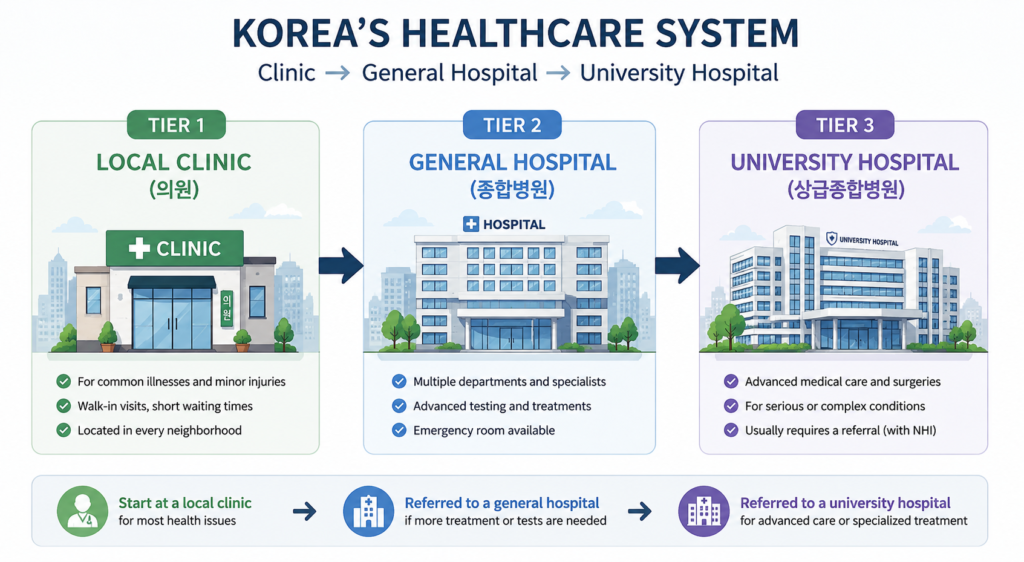
🏥 The infographic above illustrates South Korea’s three-tier healthcare system. Most people begin with a local clinic for common illnesses and are referred to larger hospitals only when specialized treatment or advanced medical care is required.
| Tier | Facility Type | Best For |
|---|---|---|
| Tier 1 | Local Clinics (의원) | Colds, flu, sore throats, minor injuries, stomach issues, and routine consultations |
| Tier 2 | General Hospitals (종합병원) | Specialist care, advanced testing, emergency treatment, and multiple medical departments |
| Tier 3 | University Hospitals (상급종합병원) | Serious illnesses, complex surgeries, and highly specialized medical treatment |
Tier 1: Local Clinics (의원)
Local clinics can be found in almost every neighborhood across Korea and are usually the first place people visit when they feel unwell.
They are ideal for:
- Colds and flu symptoms
- Sore throats
- Minor injuries
- Stomach problems
- Skin conditions
- Routine medical consultations
Most clinics accept walk-in patients, and waiting times are often less than 20 minutes.
Tier 2: General Hospitals (종합병원)
General hospitals provide a wider range of medical services and specialists than local clinics.
These hospitals typically offer:
- Multiple medical departments
- Advanced diagnostic testing
- Emergency room services
- Specialist consultations
If additional testing or specialist treatment is needed, a local clinic may refer you to a general hospital.
Tier 3: University Hospitals (상급종합병원)
University hospitals represent the highest level of medical care in Korea.
These facilities are equipped to handle serious medical conditions, complex surgeries, and advanced treatments.
Well-known examples include:
- Seoul National University Hospital
- Severance Hospital
- Samsung Medical Center
- Asan Medical Center
⚠️ Important: If you are enrolled in Korea’s National Health Insurance (NHI), you may need a referral letter before visiting a university hospital. Without a referral, your out-of-pocket medical costs may be significantly higher.
📌 Quick Summary: Which Medical Facility Should You Visit?
If you’re unsure where to go when you’re sick in Korea, the table below provides a quick overview of the most common situations and the recommended medical facility.
| Situation | Recommended Option |
|---|---|
| Common cold, fever, stomach pain | Visit a local clinic (의원) |
| Need specialist treatment | Visit a general hospital (종합병원) |
| Serious illness or surgery | Visit a university hospital (상급종합병원), usually with a referral |
| Mild symptoms late at night | Visit a nearby pharmacy or purchase OTC medicine if available |
| Emergency situation | Call 119 immediately |
For most everyday health issues, a local clinic is usually the fastest and most affordable option.
🌏 How to Find an English-Speaking Doctor in Korea
Finding an English-speaking doctor in Korea is much easier than many foreigners expect. While not every clinic offers full English support, there are several reliable ways to locate foreigner-friendly medical facilities.
The table below summarizes the most useful resources.
| Resource | Best For |
|---|---|
| 1339 Medical Hotline | Finding nearby English-speaking clinics and pharmacies |
| International Clinics | Full English support and foreign patient services |
| Global Centers | Local recommendations for foreign residents |
| Expat Communities | Real reviews and personal experiences |
📞 1339 Medical Hotline
The 1339 Medical Hotline is one of the fastest ways to find medical help in Korea.
Operators can assist in English and provide information about nearby clinics, hospitals, emergency rooms, and pharmacies.
This service is especially useful during weekends, public holidays, or late-night medical situations.
🏥 International Clinics
Many major hospitals operate dedicated international clinics for foreign patients.
These clinics often provide:
- English-speaking doctors
- Translation assistance
- International insurance support
- Foreign patient coordinators
They are an excellent option for visitors and long-term residents who prefer receiving medical care entirely in English.
🌐 Global Centers and Expat Communities
Foreign residents living in cities such as Seoul, Busan, or Incheon can also contact local Global Centers for clinic recommendations.
In addition, expat communities and online forums often share useful reviews and recommendations based on personal experience.
💡 Tip: For common illnesses such as a cold, sore throat, or minor stomach issues, a nearby clinic is usually sufficient. For more complex conditions, consider visiting a larger hospital with an international clinic.
📱 Finding an English-Speaking Doctor with Naver Map
Many foreigners initially use Google Maps to search for nearby clinics and hospitals.
However, Google Maps often provides limited or outdated local business information in Korea.
For more accurate results, consider using Naver Map, which is the most widely used navigation app in Korea. The search terms below can help you find foreigner-friendly medical facilities more quickly.
| Search Term | Best For |
|---|---|
| English Speaking Clinic | General medical care and common illnesses |
| International Clinic | Hospitals with multilingual staff and foreign patient services |
| English Pediatrician | Children’s healthcare and pediatric consultations |
| English Dentist | Dental treatment, cleanings, and emergencies |
| English Dermatologist | Skin conditions and cosmetic consultations |
| English OB-GYN | Women’s healthcare and pregnancy-related care |
💡 Tip: If you cannot find an English-speaking clinic nearby, call the 1339 Medical Hotline for assistance locating hospitals, clinics, and pharmacies that can provide English support.
📝 Step-by-Step: How to Visit a Local Doctor in Korea
Visiting a doctor in Korea is usually fast, affordable, and straightforward. Most neighborhood clinics accept walk-in patients, allowing you to receive treatment without scheduling an appointment in advance.
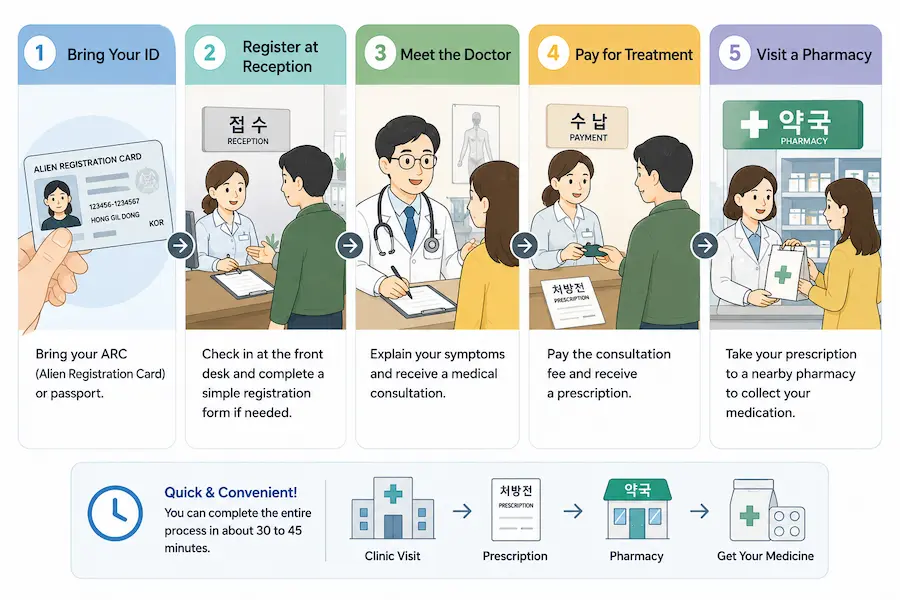
The infographic above shows the typical process of visiting a local clinic in Korea, from registration to receiving medication at a nearby pharmacy.
1️⃣ Bring Your ID
Before leaving home, make sure you have your ARC (Alien Registration Card) or passport with you. Clinics may need it to verify your identity and insurance status.
2️⃣ Register at Reception
Most clinics operate on a walk-in basis. Simply check in at the front desk and wait for your name to be called.
3️⃣ Meet the Doctor
Explain your symptoms and answer any questions the doctor may have. If you are worried about language barriers, consider writing your symptoms in English on your phone beforehand.
4️⃣ Pay for Treatment
After your consultation, return to the reception desk to pay the consultation fee and receive a prescription if medication is needed.
5️⃣ Visit a Pharmacy
Take your prescription to a nearby pharmacy. The pharmacist will prepare your medication and explain how to take it.
💡 In many cases, the entire process—from registration to receiving your medication—can be completed in less than an hour.
💰 Medical Costs in Korea
One of the biggest surprises for foreigners is how affordable healthcare can be in South Korea. The exact cost depends on whether you are covered by Korea’s National Health Insurance (NHI), but even uninsured patients often find Korean healthcare significantly cheaper than in many Western countries.
🏥 Typical Costs with National Health Insurance (NHI)
| Service | Typical Cost |
|---|---|
| Clinic Consultation | ₩3,000–₩5,000 |
| X-Rays or Basic Tests | ₩5,000–₩15,000 |
| Prescription Medication | ₩2,000–₩5,000 |
Most patients spend less than ₩10,000 (approximately $7–8 USD) for a routine clinic visit and prescription medication.
✈️ Typical Costs Without National Health Insurance
| Service | Typical Cost |
|---|---|
| Clinic Consultation | ₩15,000–₩25,000 |
| Basic Medical Treatment | Varies by clinic |
| Prescription Medication | Usually 2–3 times higher than insured rates |
Even without insurance, medical treatment in Korea is often more affordable than in countries such as the United States, Canada, or Australia.
🚫 Common Treatments Not Covered by NHI
Some services are considered non-covered treatments (비급여) and require patients to pay the full cost.
| Treatment | Typical Cost |
|---|---|
| IV Nutritional Therapy | ₩30,000–₩100,000 |
| Manual Physical Therapy | ₩50,000–₩150,000 per session |
| Cosmetic Dermatology | Varies by treatment |
| Laser Procedures | Usually not covered |
| Cosmetic Mole Removal | Usually not covered |
Patients are generally responsible for 100% of these costs unless they have additional private health insurance.
💡 Travel Insurance Tip
If you are visiting Korea as a tourist, always request the following documents after receiving treatment:
- Medical Receipt
- Medical Certificate
Many travel insurance providers require these documents when processing reimbursement claims.
💊 Getting Medicine at a Korean Pharmacy
One aspect of the Korean healthcare system that surprises many foreigners is that doctors do not usually dispense medication directly at clinics or hospitals.
Instead, after your consultation, you will receive a prescription (처방전) that must be taken to a nearby pharmacy (약국).
Fortunately, pharmacies are extremely common in Korea and are often located in the same building as the clinic or just a short walk away.
📋 How the Process Works
| Step | What Happens |
|---|---|
| 1️⃣ Visit a Doctor | Receive a medical consultation and prescription. |
| 2️⃣ Take Your Prescription | Bring the prescription to a nearby pharmacy |
| 3️⃣ Pay for Medication | Pay the medication fee, which is usually affordable. |
| 4️⃣ Receive Instructions | The pharmacist will explain how and when to take your medicine. |
Most prescriptions can be filled within a few minutes, making the process quick and convenient.
💰 Typical Medication Costs
The cost of prescription medication depends on the type of treatment and your insurance status.
| Situation | Typical Cost |
|---|---|
| With National Health Insurance (NHI) | ₩2,000–₩5,000 |
| Without Insurance | Usually higher, depending on the medication |
Even without insurance, prescription medications in Korea are often less expensive than in many Western countries.
🕒 Pharmacy Hours
Most pharmacies operate during regular business hours and are located near clinics and hospitals.
If you need medication late at night, on weekends, or during public holidays, you can:
- Search for a nearby pharmacy using Naver Map
- Call the 1339 Medical Hotline for assistance
- Visit a pharmacy operating after hours
🌙 Need Medicine Late at Night?
If you develop mild symptoms late at night, you may not need to visit a clinic immediately.
Many convenience stores in Korea sell approved over-the-counter (OTC) medications that can be purchased without a prescription.
Common convenience store chains include:
- CU
- GS25
- 7-Eleven
- Emart24
💊 Common OTC Medicines Available at Convenience Stores
| Product | Common Use |
|---|---|
| Tylenol | Fever, headaches, and minor pain relief |
| Pans Cold-A | Cold and flu symptoms |
| Festal | Indigestion and stomach discomfort |
| Pain Relief Patches | Muscle and joint pain |
These medications are intended for minor symptoms and short-term relief.
💡 If your symptoms become severe, persist for several days, or involve difficulty breathing, seek medical attention immediately rather than relying on OTC medication.
For a more detailed guide to Korean pharmacies, over-the-counter (OTC) medications, and finding a pharmacy on weekends or public holidays, check out our complete pharmacy guide.
👉 Korean Pharmacy Guide
🗣️ Useful Korean Medical Phrases
Most doctors in Korea can understand basic medical English, but receptionists and pharmacists may not always speak English fluently.
Saving a few simple phrases on your phone can make your clinic visit much easier.
🏥 At Reception
| Korean | Pronunciation | English |
|---|---|---|
| 처음 왔어요 | Cheo-eum wasseoyo | This is my first time here. |
| 건강보험 있어요 | Geongang boheom isseoyo | I have National Health Insurance. |
| 영어 가능한 의사 선생님 계신가요? | Yeong-eo ganeunghan uisa seonsaengnim gyesingayo? | Is there an English-speaking doctor available? |
🤒 Explaining Your Symptoms
| Korean | Pronunciation | English |
|---|---|---|
| 머리가 아파요 | Meoriga apayo | I have a headache. |
| 배가 아파요 | Baega apayo | I have a stomachache. |
| 목이 아파요 | Mogi apayo | I have a sore throat. |
| 열이 나요 | Yeori nayo | I have a fever. |
| 감기에 걸렸어요 | Gamgie geollyeosseoyo | I have a cold. |
| 기침이 나요 | Gichimi nayo | I have a cough. |
| 어지러워요 | Eojireowoyo | I feel dizzy. |
| 약 알레르기 있어요 | Yak allereugi isseoyo | I have a medication allergy. |
| 임신 중이에요 | Imsin jungieyo | I am pregnant. |
💡 Tip: If you’re unsure about pronunciation, simply show these phrases on your phone. Most Korean clinic staff will immediately understand what you need.
⚠️ Common Mistakes Foreigners Make
South Korea’s healthcare system is generally easy to use, but many foreigners make the same mistakes during their first clinic visit.
Avoiding the common issues below can save you time, money, and unnecessary stress.
| Common Mistake | What to Do Instead |
|---|---|
| Going directly to a large university hospital for a minor illness | Visit a local clinic first for faster and more affordable treatment. |
| Forgetting to bring your ARC or passport | Always carry identification when visiting a clinic or hospital. |
| Assuming doctors dispense medication directly | Take your prescription to a nearby pharmacy (약국). |
| Using Google Maps only | Use Naver Map for more accurate clinic and pharmacy information in Korea. |
| Waiting too long during a serious medical emergency | Call 119 immediately if you experience a medical emergency. |
💡 Helpful Reminder
Most medical visits in Korea are much simpler than many foreigners expect. Local clinics are widely available, wait times are usually short, and pharmacies are often located just steps away from the clinic.
✅ When in doubt, start with a nearby clinic. Most common illnesses can be diagnosed and treated quickly without visiting a large hospital.
❓ Frequently Asked Questions
Q. Can tourists visit hospitals in Korea?
Yes.
Tourists can visit clinics, hospitals, and emergency rooms using their passport.
Although costs are generally higher without National Health Insurance (NHI), healthcare in Korea is often more affordable than in many Western countries.
Q. Do Korean doctors speak English?
Many doctors, especially in larger cities and university hospitals, can communicate in English.
You can also search for English-speaking clinics using Naver Map or contact the 1339 Medical Hotline for assistance.
Q. Is healthcare expensive in Korea?
No.
With National Health Insurance (NHI), many routine clinic visits cost less than ₩10,000 out of pocket, including consultation and medication.
This makes Korea one of the most affordable developed countries for healthcare.
Q. Do I need an appointment to see a doctor?
Usually not.
Most neighborhood clinics in Korea accept walk-in patients, and waiting times are often less than 30 minutes.
Q. What should I bring to a clinic?
Bring your ARC (Alien Registration Card) or passport.
Having your identification ready will help the clinic verify your identity and insurance status.
Q. Can I go directly to a specialist?
Yes.
Unlike some countries, many specialists in Korea can be visited directly without first seeing a general practitioner.
However, larger university hospitals may require a referral for certain services.
Q. How do I get my medication after seeing a doctor?
After your consultation, the doctor will provide a prescription.
Take the prescription to a nearby pharmacy (약국), where a pharmacist will prepare your medication and explain how to take it.
Q. What should I do if I get sick late at night?
For minor symptoms, many convenience stores sell approved over-the-counter (OTC) medications.
For urgent medical concerns, call 1339 for medical guidance or 119 for emergencies.
Q. What should I do during a medical emergency?
Call 119 immediately.
Ambulance services operate 24 hours a day throughout Korea and can provide emergency medical assistance when needed.
🎯 Final Thoughts
Before leaving home, make sure you have:
☑ Your ARC (Alien Registration Card) or passport
☑ A payment method
☑ Naver Map installed
☑ The clinic address saved
☑ Basic Korean medical phrases
☑ A referral letter (if visiting a university hospital)
South Korea’s healthcare system is generally fast, affordable, and easy to navigate, even for foreigners visiting a doctor for the first time.
Whether you’re dealing with a common cold, a child’s fever, or an unexpected health concern, understanding how the system works can save you time, money, and unnecessary stress.
💡 With a little preparation, visiting a doctor in Korea can be a simple and stress-free experience.
📚 Related Korea Living Guides
Medical Emergency in Korea: How to Use 119 and 1339
Best Navigation Apps in Korea
How to Get a Korea ARC (Residence Card): Complete Guide