Korean credit card for foreigners can seem difficult to obtain at first.
Moving to South Korea is exciting, but one thing surprises many foreigners: getting a Korean credit card is often much harder than opening a bank account.
A foreign friend of mine recently shared how frustrated he was after being rejected for a credit card despite having a stable job and a valid Residence Card. Like many newcomers, he assumed the process would be straightforward.
The reality is that Korean banks usually do not consider your overseas credit history. Instead, they focus on factors such as your visa status, income, employment history, and financial activity within Korea.
The good news is that approval is absolutely possible once you understand how the system works.
In this guide, you’ll learn who qualifies, what documents you need, the easiest ways to get approved, and what to do if your application is rejected.
💳 Why Is It More Difficult for Foreigners to Get a Korean Credit Card?
The biggest reason is simple: card companies want to see a stable financial history in Korea.
Unlike Korean citizens, many foreigners have a shorter residency history, limited local credit records, or visas that require periodic renewal.
Because of this, card issuers often pay close attention to factors such as:
✔ Visa type
✔ Employment status
✔ Income earned in Korea
✔ Average bank account balance
✔ Length of residence in Korea
However, this does not mean foreigners cannot get a Korean credit card.
It simply means that approval requirements are often stricter, especially for new residents who have not yet built a financial history in Korea.
📋 Basic Requirements
Before applying for a Korean credit card, most issuers expect applicants to meet several basic requirements.
| Requirement | Why It Matters |
|---|---|
| 🪪 Valid Residence Card (ARC) | Required for identity and residency verification |
| 📅 Valid Visa Status | Most issuers prefer applicants with at least 3–6 months remaining on their visa |
| 💼 Stable Financial Activity | Helps demonstrate financial reliability and repayment ability |
🪪 Valid Residence Card (ARC)
Tourists and short-term visitors are generally not eligible for Korean credit cards.
To apply, you must hold a valid Residence Card (formerly known as an Alien Registration Card).
📅 Valid Visa Status
Many banks prefer applicants whose visa remains valid for at least 3 to 6 months.
If your visa is close to expiration, renewing it before applying may improve your approval chances.
💼 Stable Financial Activity
Card issuers typically want to see evidence of a stable financial history in Korea.
This may include:
✔ Regular salary deposits
✔ National Health Insurance records
✔ Savings or investment balances
✔ Property ownership in Korea
Meeting these basic requirements does not guarantee approval, but it can significantly increase your chances of getting approved.
📊 Typical Approval Chances by Visa Type
While approval standards vary between card issuers, your visa type can play a major role in the application process.
In general, long-term resident visas tend to have the highest approval rates, while student and job-seeker visas may face additional restrictions.
| Visa Type | Typical Approval Chances |
|---|---|
| F-5 Permanent Resident | 🟢 High |
| F-6 Marriage Visa | 🟢 High |
| F-2 Resident Visa | 🟢 High |
| F-4 Overseas Korean Visa | 🟢 High |
| E-7 Professional Visa | 🟡 Moderate |
| E-2 Teaching Visa | 🟡 Moderate |
| D-2 Student Visa | 🔴 Low |
| D-10 Job Seeker Visa | 🔴 Low |
Keep in mind that visa type is only one factor. Card issuers may also review your income, employment history, average account balance, and overall financial activity in Korea before making a final decision.
🛠️ Three Common Ways to Qualify
Most foreigners are approved through one of the following three methods.
| Qualification Method | Best For | Key Requirement |
|---|---|---|
| 💼 Employment-Based Approval | Employees on E-series or F-series visas | Stable income and employment history |
| 💰 Average Balance Method | Students, freelancers, self-employed residents | Maintaining a healthy account balance |
| 🏠 Property Ownership | Property owners in Korea | Proof of ownership and financial stability |
💼 Path 1: Employment-Based Approval
This is the most common route for foreigners living in Korea.
Most card issuers prefer applicants who:
✔ Have worked in Korea for at least 3–6 months
✔ Receive a regular salary
✔ Contribute to National Health Insurance
For many foreigners on E-series or F-series visas, this is usually the easiest way to qualify.
💰 Path 2: Average Balance Method
Some banks may approve applicants based on their banking history rather than employment.
This option is often used by:
✔ Students
✔ Freelancers
✔ Self-employed residents
✔ Stay-at-home spouses
Maintaining a healthy average account balance for several months can improve your chances of approval.
Some banks also offer secured credit cards backed by a fixed deposit.
🏠 Path 3: Property Ownership
Foreigners who own property in Korea may find it easier to qualify for a credit card.
Property ownership can demonstrate:
✔ Financial stability
✔ Long-term residence plans
✔ Stronger ties to Korea
Depending on the issuer, you may be asked to provide property ownership documents and tax records during the application process.
📑 Documents You May Need
The exact documents required may vary by bank and card issuer, but preparing the following documents in advance can make the application process much smoother.
| Category | Common Documents |
|---|---|
| 🪪 Identity Documents | Passport, Residence Card (ARC) |
| 💼 Employment Documents | Certificate of Employment, Proof of Income, Salary Deposit Records |
| 💰 Financial Documents | Bank Balance Certificate, Average Balance Statement, Fixed Deposit Records (if applicable) |
🪪 Identity Documents
Most issuers will require:
✔ Passport
✔ Residence Card (ARC)
These documents are used to verify your identity and legal residency status in Korea.
💼 Employment Documents
If you are applying through the employment-based route, you may need:
✔ Certificate of Employment
✔ Proof of Income
✔ Salary Deposit Records
These documents help demonstrate a stable source of income and employment history.
💰 Financial Documents
If you are applying based on savings or assets, you may be asked to provide:
✔ Bank Balance Certificate
✔ Average Balance Statement
✔ Fixed Deposit Records (if applicable)
These documents help issuers assess your financial stability and repayment ability.
💡 Tip: Bringing complete and up-to-date documents can significantly speed up the review process and reduce the risk of delays.
🏦 Best Korean Credit Card Companies for Foreigners
🏦 Best Korean Credit Card Companies for Foreigners
While approval requirements vary by issuer, some credit card companies in Korea are generally considered more foreigner-friendly than others.
If you’re applying for your first Korean credit card, the following options are often a good place to start.
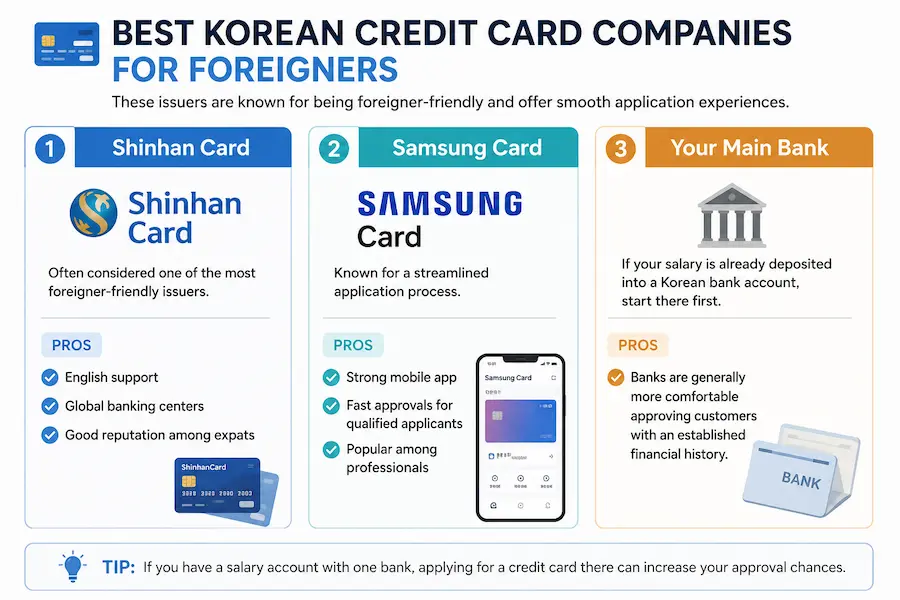
🏦 Shinhan Card
Shinhan Card is often regarded as one of the most foreigner-friendly card issuers in Korea, particularly for expats who prefer English support and international banking services.
✅ Why Many Foreigners Choose Shinhan Card
✔ English customer support
✔ Global Banking Centers in major cities
✔ Strong reputation among expats and international residents
For the latest card products, benefits, and eligibility requirements, visit the Shinhan Card Official Website.
📱 Samsung Card
Samsung Card is known for its simple application process and user-friendly mobile app.
✅ Why Many Foreigners Choose Samsung Card
✔ Excellent mobile app experience
✔ Fast approvals for qualified applicants
✔ Popular among office workers and professionals
For the latest credit card options, benefits, and application information, visit the Samsung Card Official Website.
💳 Your Main Bank
If your salary is already deposited into a Korean bank account, it may be worth applying for a credit card with that bank first.
Banks are often more comfortable approving customers who already have an established banking relationship and transaction history.
✅ Why Applying Through Your Main Bank Can Help
✔ Existing banking relationship
✔ Easier income and identity verification
✔ Potentially higher approval chances
For bank-specific credit cards and eligibility requirements, check your bank’s official website or mobile app, or speak with a representative at your local branch.
📊 Which Option Should You Choose?
| Situation | Recommended Option |
|---|---|
| Need English support | Shinhan Card |
| Prefer a great mobile app | Samsung Card |
| Already receive your salary in Korea | Your Main Bank |
| First credit card in Korea | Your Main Bank or Shinhan Card |
💡 Tip: Many foreigners report positive experiences with Shinhan Card, Samsung Card, and the bank where they already receive their salary.
Building a financial history with a Korean bank can improve your chances of being approved not only for a credit card, but also for future products such as higher credit limits, loans, and additional banking services.
💳 Credit Card vs Check Card
If you’re not eligible for a Korean credit card yet, don’t worry.
For many foreigners, a Korean check card (debit card) is an excellent alternative and can handle most everyday payments.
📊 Credit Card vs Check Card Comparison
| Feature | 💳 Credit Card | 💳 Check Card (Debit Card) |
|---|---|---|
| Credit Check | Required | Not Required |
| Approval Difficulty | Moderate | Easy |
| Spending Limit | Based on approved credit limit | Limited to available account balance |
| Rewards & Benefits | Usually better | More limited |
| Foreigner Accessibility | Moderate | Very High |
| Application Speed | Several days to weeks | Often available immediately |
✅ Why Many Foreigners Start with a Check Card
A Korean check card is often the easiest way to begin building your financial history in Korea.
Benefits include:
✔ Easy approval process
✔ Direct access to your bank account
✔ Widely accepted throughout Korea
✔ Compatible with Samsung Pay, Naver Pay, and Kakao Pay
✔ No credit history required
For many newcomers, a check card provides nearly all the convenience of a credit card while avoiding the stricter approval requirements.
💡 Tip: If you’re unable to qualify for a credit card right away, using a Korean check card and maintaining regular banking activity can help strengthen your financial profile for future applications.
💡 How to Improve Your Approval Chances
Getting approved for a Korean credit card can sometimes be challenging, but there are several ways to improve your chances.
✅ Best Practices Before Applying
| Tip | Why It Matters |
|---|---|
| 🪪 Keep Your Information Consistent | Your name should match exactly across your Residence Card, mobile phone account, and bank account. |
| 🏦 Apply Through Your Main Bank | Banks are often more comfortable approving customers with an existing banking relationship. |
| 💳 Start with a Lower Credit Limit | A modest credit limit may be easier to approve than a high-limit request. |
| 📈 Build Local Financial History | Regular salary deposits, bill payments, and active banking history can strengthen your profile. |
📌 Quick Checklist
Before submitting your application, make sure:
✔ Your Residence Card is valid
✔ Your visa has sufficient remaining validity
✔ Your name is consistent across all accounts
✔ You can provide supporting documents if requested
🚫 What If Your Application Is Rejected?
A rejection does not necessarily mean you won’t qualify in the future.
Many foreigners are approved after improving one or more of the following factors:
✔ Extending their visa
✔ Increasing their average account balance
✔ Building additional employment history
✔ Applying through their primary bank
✔ Establishing more financial activity in Korea
In the meantime, a Korean check card (debit card) can provide most of the convenience of a credit card while you continue building your local financial profile.
💡 Remember: Many successful applicants are not approved on their first attempt. Building a stronger financial history in Korea often makes a significant difference over time.
❓ Frequently Asked Questions
Q. Can I get a Korean credit card without a full-time job?
Possibly.
Some banks may consider factors such as your account balance, savings, or other financial assets instead of traditional employment.
Q. Will my credit score from my home country help in Korea?
In most cases, no.
Korean card issuers generally evaluate your financial history within Korea rather than your overseas credit record.
Q. Is a check card enough for daily life in Korea?
For most people, yes.
A Korean check card can be used for shopping, online payments, transportation, and mobile payment services such as Samsung Pay, Naver Pay, and Kakao Pay.
Q. What is the easiest way to improve my approval chances?
Building a stable financial history in Korea is usually the most effective approach.
Regular salary deposits, active bank account usage, and maintaining a healthy account balance can all help strengthen your application.
Q. Should I apply through my bank or a card company?
If possible, start with the bank where you already receive your salary.
Having an existing banking relationship may improve your chances of approval and simplify the application process.
🎯 Final Thoughts
Getting a Korean credit card as a foreigner may seem difficult at first, but it becomes much easier once you understand the requirements.
For most applicants, the keys to approval are a valid visa, stable financial activity, and a strong banking history in Korea.
If you’re not eligible yet, a Korean check card can be a great alternative while you build your financial profile.
With the right preparation, many foreigners successfully obtain a Korean credit card and enjoy the convenience of Korea’s cashless lifestyle.
📚 Related Korea Living Guides
New to Korea? These guides can help make everyday life easier:
How to Open a Bank Account in Korea as a Foreigner
Toss Bank Account for Foreigners: How to Open One in Korea
Resident vs Non-Resident Bank Accounts in Korea