This Korean Pharmacy Guide explains everything you need to know about buying medicine in South Korea. If you’re wondering how to buy medicine in Korea, the process is usually easier than many foreigners expect.
Whether you’re dealing with a headache, a cold, an upset stomach, or seasonal allergies, knowing where to get the right medicine can make a big difference.
The good news is that Korean pharmacies are easy to find, affordable, and well stocked with medications for common health issues.
However, the Korean pharmacy system may feel unfamiliar to many foreigners. Unlike large drugstores in countries such as the United States, Canada, or the United Kingdom, pharmacies in Korea are usually smaller and operate under stricter regulations.
Many medications are kept behind the counter, and customers often speak directly with a pharmacist to receive recommendations and advice.
💊 In this guide, you’ll learn how pharmacies in Korea work, where to buy over-the-counter (OTC) medicine, common medication brands, useful pharmacy phrases, and important safety tips for foreigners living in or visiting South Korea.
🏥 Korean Pharmacy Guide for First-Time Visitors
The Korean word for pharmacy is:
💊 Yakguk (약국)
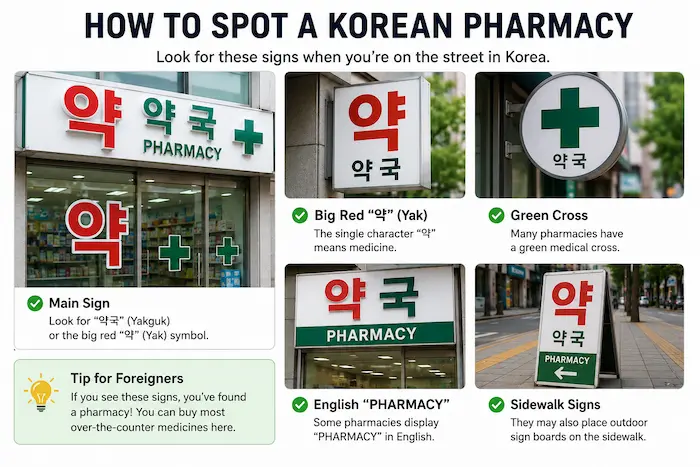
When walking around Korea, look for signs that say:
- 약국
- Pharmacy
- ➕ A green or red medical cross
📍 Where Can You Find Pharmacies?
Pharmacies are extremely common in Korea and are usually located near:
| 📍 Location | Availability |
|---|---|
| 🏥 Hospitals and clinics | Very common |
| 🚇 Subway stations | Common |
| 🏢 Apartment complexes | Common |
| 🛍️ Shopping districts | Common |
💡 In most Korean neighborhoods, you’ll find at least one pharmacy within walking distance.
Because pharmacies are so easy to find, getting medicine for common illnesses such as colds, headaches, stomach problems, or allergies is usually quick and convenient.
In most neighborhoods, finding a Korean pharmacy is usually quick and convenient.
⏰ Pharmacy Opening Hours in Korea
Most Korean pharmacies follow similar business hours, but exact opening times can vary by location.
| Day | Typical Opening Hours |
|---|---|
| Monday – Friday | 9:00 AM – 8:00 PM |
| Saturday | 9:00 AM – 2:00 PM |
| Sunday & Public Holidays | Many pharmacies are closed |
However, some designated pharmacies remain open on weekends, public holidays, and late at night.
If you need medicine outside normal business hours, call:
📞 1339
The operator can help you find an open pharmacy, clinic, or emergency room nearby.
📍 Finding a Korean Pharmacy on Weekends
Weekend pharmacy hours can be limited in Korea. Many pharmacies close early on Saturdays and are closed on Sundays or public holidays.
If you need medicine during the weekend, try these options:
| Option | What to Do |
|---|---|
| 🗺️ Naver Map | Search for pharmacies that are currently open. |
| 🏥 Holiday Pharmacies | Look for designated weekend or holiday pharmacies. |
| 📞 1339 Hotline | Call 1339 for real-time pharmacy information. |
This is especially useful if you need cold medicine, digestive medicine, allergy medication, or children’s medicine outside regular hours.
💡 Tip: Convenience stores in Korea sell only a limited selection of basic medicines. For most medications, you will need to visit a pharmacy, so finding an open one can be important.
💊 How the Korean OTC Medicine System Works
Understanding how a Korean pharmacy works can help you choose the right place to buy OTC medicine.
In Korea, medicines generally fall into two categories:
| Type | Prescription Required? | Examples |
|---|---|---|
| 🩺 Prescription Medicine | ✅ Yes | Antibiotics, strong pain medication, hormonal treatments, certain chronic disease medications |
| 💊 OTC (Over-the-Counter) Medicine | ❌ No | Cold medicine, fever reducers, pain relievers, digestive medicine, allergy medication, motion sickness tablets, ointments |
🩺 Prescription Medicine
Prescription medicines require a doctor’s prescription, so you must first visit a clinic or hospital before purchasing them.
💊 OTC Medicine
OTC medicines can be purchased directly from a pharmacist without a prescription.
However, pharmacists may ask a few questions about:
- Your symptoms
- How long you’ve been sick
- Any existing medical conditions
- Current medications or allergies
💡 Unlike in some countries, many medications that are sold in supermarkets or large drugstores overseas can only be purchased at a pharmacy in Korea.
🛒 Why Don’t Korean Pharmacies Display Many Medicines on Shelves?
Many foreigners are surprised when they visit a pharmacy in Korea.
Unlike large Western drugstores, most medications are not displayed openly on shelves.
Instead, you’ll usually see products such as:
- 💊 Vitamins and supplements
- 😷 Face masks
- 🥤 Health drinks
- 🧴 Personal care products
Most medicines are kept behind the counter.
If you need medication, simply describe your symptoms to the pharmacist, and they will recommend an appropriate product.
💡 This system helps prevent the misuse of medication and allows pharmacists to provide more personalized advice before you purchase medicine.
🤒 Best OTC Medicine for Colds in Korea
Seasonal colds are one of the most common reasons foreigners visit a pharmacy.
Common symptoms include:
- 🤧 Runny nose
- 😷 Sore throat
- 😮💨 Cough
- 👃 Nasal congestion
- 🤒 Mild fever
| Medicine | Common Use |
|---|---|
| 💊 Pancold | General cold symptoms |
| 💊 Moducol | Multiple cold symptoms, including cough and congestion |
| 💊 Zyrtec | Allergy-related congestion and sneezing |
💡 Instead of asking for a specific brand, simply describe your symptoms. Korean pharmacists will usually recommend the most suitable medicine.
🤕 Best OTC Medicine for Headaches and Pain
Headaches, muscle pain, and minor injuries are common travel-related problems.
| Medicine | Best For |
|---|---|
| 💊 Tylenol | Fever, headaches, and general pain relief |
| 💊 Ibuprofen Products | Inflammation, muscle soreness, and menstrual cramps |
| 💊 Naproxen-Based Medicines | Back pain, sports injuries, and dental pain |
⚠️ Always follow the dosage instructions provided by the pharmacist or listed on the package.
🤢 Best OTC Medicine for Stomach Problems
Korean food is delicious, but some visitors experience digestive issues while adjusting to new flavors and spices.
Common symptoms include:
- 🤢 Indigestion
- 🔥 Heartburn
- 🎈 Bloating
- 🚽 Mild diarrhea
| Medicine | Common Use |
|---|---|
| 💊 Festal | Digestive support after meals |
| 💊 Bearse | Bloating and indigestion relief |
| 💊 Gaviscon | Acid reflux and heartburn |
| 💊 Anti-Diarrheal Medication | Mild diarrhea and stomach upset |
⚠️ If your symptoms are severe, persistent, or accompanied by a high fever, seek medical attention instead of relying solely on OTC medicine.
🤧 Best OTC Allergy Medicine in Korea
Seasonal allergies affect many residents and visitors throughout the year, especially during spring and autumn.
Common symptoms include:
- 🤧 Sneezing
- 👃 Runny nose
- 👁️ Itchy or watery eyes
- 😮💨 Nasal congestion
| Medicine | Common Use |
|---|---|
| 💊 Zyrtec | General allergy relief |
| 💊 Cetirizine Products | Generic allergy medications with similar effects |
| 💊 Claritin | Non-drowsy allergy relief |
| 💊 Allegra | Seasonal allergies and hay fever symptoms |
💡 If you’re unsure which medicine to choose, simply tell the pharmacist about your symptoms. They can recommend the most appropriate option based on your medical history and whether you need a non-drowsy medication.
🗣️ Useful Korean Pharmacy Phrases
🗣️ Useful Korean Pharmacy Phrases
Speaking Korean isn’t required when visiting a pharmacy in Korea, but knowing a few basic phrases can make communication much easier.
| Korean Phrase | Pronunciation | Meaning |
|---|---|---|
| 약 좀 주세요 | Yak Jom Juseyo | Please give me some medicine. |
| 머리가 아파요 | Meoriga Apayo | I have a headache. |
| 배가 아파요 | Bae-ga Apayo | My stomach hurts. |
| 목이 아파요 | Mok-i Apayo | I have a sore throat. |
| 기침이 나요 | Gichimi Na-yo | I have a cough. |
| 열이 나요 | Yeori Na-yo | I have a fever. |
| 감기약 주세요 | Gamgi-yak Juseyo | Please give me cold medicine. |
💡 Tip: If you’re unsure which medicine to buy, simply describe your symptoms. Most pharmacists are familiar with helping foreign visitors and can usually recommend an appropriate medication.
📦 How to Read Korean Medicine Instructions
📦 How to Read Korean Medicine Instructions
Korean medicine packaging often includes common dosage instructions that may be unfamiliar to foreign visitors.
Here are a few useful terms to know:
| Korean | Pronunciation | Meaning |
|---|---|---|
| 하루 세 번 | Ha-ru Sam-beon | Take three times per day |
| 식후 30분 | Sikhu Samsip Bun | Take 30 minutes after meals |
| 식전 | Sikjeon | Take before meals |
| 두 알씩 | Du Al-ssik | Take two tablets at a time |
💡 Tip: “식후 30분 (Sikhu Samsip Bun)” is one of the most common dosage instructions you’ll see on Korean medicine packaging.
Always confirm the dosage instructions and usage directions with the pharmacist before leaving the pharmacy.
🌙 Can You Buy Medicine at Convenience Stores?
Yes, but the selection is very limited.
Some convenience stores in Korea sell a small number of basic medicines, including:
- 💊 Tylenol
- 💊 Basic pain relievers
- 💊 Digestive medicine
- 💊 Simple cold and fever remedies
However, convenience stores carry far fewer medications than pharmacies and do not provide professional medical advice.
| Location | What You Can Buy |
|---|---|
| 🏪 Convenience Store | A limited selection of basic medicines |
| 💊 Pharmacy (Yakguk) | A wider range of medications and pharmacist recommendations |
💡 If you’re unsure which medicine you need, it’s usually best to visit a pharmacy. A pharmacist can recommend a more appropriate medication based on your symptoms and medical history.ommend a more appropriate option than what’s available at a convenience store.
🚨 When Should You See a Doctor Instead?
Over-the-counter (OTC) medicine can help relieve many common symptoms, but some situations require professional medical attention.
You should visit a clinic or hospital if you experience:
- 🤒 A high fever that lasts several days
- 🤕 Severe or worsening stomach pain
- 😮💨 Difficulty breathing
- 🤢 Persistent vomiting
- 🤧 Serious allergic reactions
- 📈 Symptoms that continue to worsen despite treatment
⚠️ Pharmacists can provide helpful advice and recommend medications, but they cannot replace a doctor’s diagnosis or medical treatment.
💡 If your symptoms are severe, persistent, or causing concern, it’s always safer to seek professional medical care rather than relying solely on OTC medicine.
❓ Frequently Asked Questions
Q. Do I need a prescription to buy medicine in Korea?
Not always.
Many medicines, such as cold medicine, pain relievers, and digestive remedies, can be purchased directly from a pharmacy. However, antibiotics and certain stronger medications require a doctor’s prescription.
Q. Can I use my foreign credit card at a Korean pharmacy?
Usually, yes.
Most pharmacies in Korea accept international credit and debit cards, although some smaller pharmacies may prefer cash or Korean cards.
Q. Can I bring my prescription medicine into Korea?
Generally, yes, but some medications are restricted or controlled substances in Korea.
If you’re bringing prescription medication from overseas, it’s a good idea to carry:
- Your prescription
- A doctor’s note (if available)
- The medication in its original packaging
Q. What should I do if I’m not sure which medicine I need?
Simply describe your symptoms to the pharmacist.
Korean pharmacists can often recommend an appropriate OTC medication or advise you to visit a clinic if your symptoms require medical attention.
Q. Are pharmacies easy to find in Korea?
Yes.
Pharmacies are extremely common and can usually be found near hospitals, clinics, subway stations, and residential neighborhoods.
🎯 Final Thoughts
Buying medicine in Korea is usually quick, affordable, and straightforward. Once you understand how the Korean pharmacy system works, finding treatment for common issues such as colds, headaches, allergies, or stomach problems becomes much easier.
Remember to look for a nearby Yakguk (약국), explain your symptoms clearly, and don’t hesitate to ask the pharmacist for help. Korean pharmacists are highly trained healthcare professionals and can often recommend the right medication for minor illnesses.
Whether you’re visiting Korea for a few weeks or living here long-term, understanding how a Korean pharmacy works can save you time, money, and unnecessary stress.
💡 A quick conversation with a pharmacist can often solve a minor health problem before it becomes a bigger issue, making Korean pharmacies one of the most useful healthcare resources for foreigners in Korea.
📚 Related Korea Living Guides
New to Korea? These guides will help you settle in faster :
How to Visit a Doctor in Korea as a Foreigner
Medical Emergency in Korea: How to Use 119 and 1339
How to Get National Health Insurance (NHIS) in Korea for Foreigners
8 Essential Apps Every Foreigner Needs in Korea