If you’re new to South Korea, using an ATM for the first time can feel a little confusing.
Fortunately, Korean ATMs are modern, secure, and widely available throughout the country. Most major banks offer multilingual support, making it easy for tourists, international students, expats, and long-term residents to access essential banking services.
Whether you need to withdraw cash, transfer money, check your account balance, or use an international card, understanding how Korean ATMs work can help you avoid unnecessary fees and save time.
In this guide, you’ll learn everything you need to know about using an ATM in Korea, including cash withdrawals, money transfers, ATM fees, withdrawal limits, Global ATMs, and common mistakes to avoid.
🌏 Can Foreigners Use ATMs in Korea?
Absolutely.
Foreign residents, tourists, international students, and business travelers can all use Korean ATMs.
Most major banks provide multilingual ATM support, making everyday banking much easier for non-Korean speakers.
🌐 Language Support
| Available Languages |
|---|
| ✅ English |
| ✅ Chinese |
| ✅ Japanese |
| ✅ Vietnamese |
If the ATM screen appears in Korean, simply select Foreign Languages and choose your preferred language.
💳 International Cards Accepted
Many Korean ATMs display a Global ATM logo, which indicates support for international debit and credit cards.
Most Global ATMs accept major card networks, including Visa, Mastercard, JCB, UnionPay, Cirrus, and Maestro, making them a convenient option for tourists and short-term visitors.
💡 If you’re visiting Korea for a short trip, look for a Global ATM whenever possible. These machines are generally the most reliable option for international cards and foreign-issued bank accounts.r possible. These machines are generally the most reliable option for international cards.
💵 Why You May Still Need Cash in Korea
Korea is one of the most cashless countries in the world, and most restaurants, convenience stores, taxis, and shops accept card payments.
However, carrying a small amount of cash is still recommended for:
✅ Traditional markets
✅ Street food vendors
✅ Small local businesses
✅ Rural areas
✅ Emergency situations
✅ Transportation card top-ups
While many visitors can go days without using cash, knowing how to withdraw money from an ATM can be extremely useful when you need it.raw money from an ATM can be extremely helpful when needed.
📍 Where Can You Find an ATM in Korea?
ATMs are widely available throughout South Korea and can be found in most places that travelers visit regularly.
| Location | Details |
|---|---|
| 🏦 Banks | The most reliable option. Common banks include KB Kookmin Bank, Shinhan Bank, Hana Bank, Woori Bank, and NH NongHyup. |
| 🏪 Convenience Stores | Many ATMs operate 24/7 and can be found inside CU, GS25, 7-Eleven, and Emart24. |
| 🚇 Subway Stations | Most major subway stations have one or more ATMs available. |
| ✈️ Airports | Global ATMs are available at Incheon, Gimpo, and Gimhae airports, making it easy to withdraw cash immediately after arrival. |
💡 For international visitors, airport Global ATMs and major bank ATMs are usually the safest and most reliable options for overseas cards.
🔐 ATM Safety Tips
Before using an ATM in Korea, keep these basic security tips in mind.
| Safety Tip | Why It Matters |
|---|---|
| 🔑 Use a Strong PIN | Avoid using birthdays, phone numbers, or your Alien Registration Number (ARC), as these are easier to guess. |
| ✋ Cover the Keypad | Always shield the keypad when entering your PIN to prevent others from seeing it. |
| 🚫 Never Share Your Account | Never lend your bank account, card, or bankbook to another person. This may be linked to financial fraud or illegal activities. |
| 🏦 Use Trusted ATMs | Whenever possible, use ATMs located inside banks, convenience stores, or subway stations, and avoid suspicious or damaged machines. |
💡 A few simple precautions can help protect your money and personal information while using ATMs in Korea.
💳 How to Withdraw Cash from a Korean ATM
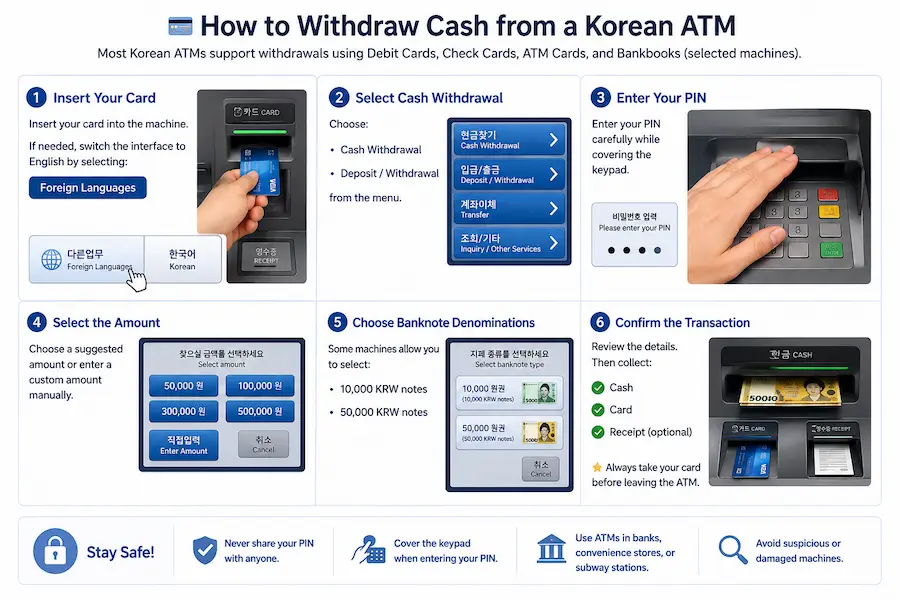
The infographic above shows the basic steps for withdrawing cash from a Korean ATM. Most ATMs support English and other foreign languages, making them easy for tourists and expats to use.
If you’re using an overseas debit or credit card, try to use a Global ATM whenever possible. These machines are specifically designed for international card networks and typically provide the smoothest withdrawal experience.
Always verify the transaction amount, take your card before leaving, and keep your receipt for reference if any issues occur.
💰 ATM Withdrawal Fees in Korea
ATM fees in Korea vary depending on several factors, including your bank, the ATM operator, the time of day, and your account type.
Typical ATM Withdrawal Fees
| Situation | Typical Fee |
|---|---|
| 🏦 Using your own bank’s ATM during business hours | Usually Free |
| 🏧 Using another bank’s ATM | 600–1,000 KRW |
| 🌙 Late-night withdrawals | 600–1,000 KRW |
💡 Many Korean banks waive ATM fees for customers who use them as their primary bank.
💡 Pro Tip
Whenever possible, use your own bank’s ATM during regular banking hours. This is usually the easiest way to avoid additional withdrawal fees.
📊 ATM Withdrawal Limits
For security reasons, Korean banks apply daily and per-transaction withdrawal limits.
Typical Withdrawal Limits
| Limit Type | Typical Amount |
|---|---|
| 💳 Per Transaction | 700,000–1,000,000 KRW |
| 📅 Daily Limit | Around 6,000,000 KRW |
⚠️ Actual limits may vary depending on the bank, account type, and customer verification level.
If you need to withdraw a larger amount, you may need to visit a bank branch during business hours.
🌍 Using International Cards at Korean ATMs
Many visitors to Korea prefer using their overseas debit or credit cards instead of opening a local bank account.
Fortunately, this is usually possible at:
✅ Global ATMs
✅ Global ATMs at Airports
✅ Major Bank ATMs
However, there are a few important things to keep in mind.
💳 Supported Card Networks
Most Korean Global ATMs accept major international card networks, including Visa, Mastercard, JCB, UnionPay, Cirrus, and Maestro.
💡 For the best experience, look for a “Global ATM” logo before inserting your card.
💸 Additional Fees to Consider
Even if the Korean ATM itself charges little or no fee, your home bank may still apply additional charges, such as:
✅ Foreign transaction fees
✅ Currency conversion fees
✅ International withdrawal fees
⚠️ Always check your bank’s international ATM policy before traveling to Korea.
💡 Dynamic Currency Conversion (DCC)
When using an international card, some Korean ATMs may ask whether you would like the transaction processed in Korean Won (KRW) or your home currency.
In most cases, choosing Korean Won (KRW) provides a better exchange rate and helps you avoid additional conversion markups.
✅ Recommended Option: Korean Won (KRW)
Choosing your home currency may seem more convenient, but it often results in a less favorable exchange rate and higher overall costs.
🔄 How to Transfer Money Using a Korean ATM
Bank transfers are one of the most common payment methods in South Korea. They are widely used for rent payments, utility bills, online purchases, and second-hand marketplace transactions.
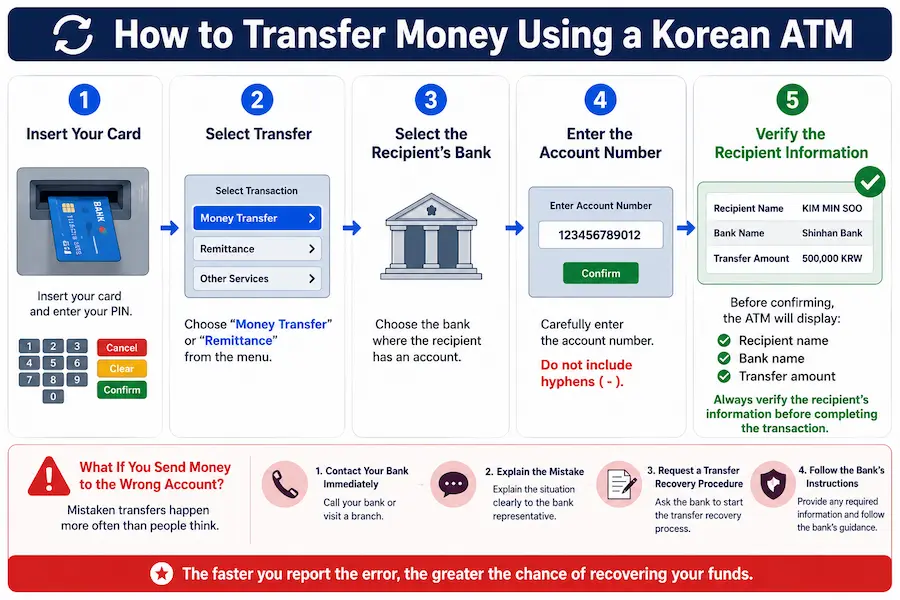
The infographic above shows the basic steps for transferring money using a Korean ATM, including what to do if money is accidentally sent to the wrong account.
🚨 Before confirming any transfer, always verify the recipient’s name, bank name, account number, and transfer amount displayed on the screen.
Verifying the recipient’s information is the most important step in the entire transfer process.
Even a small mistake can result in money being sent to the wrong account, and recovering those funds may take time.
If an error occurs, contact your bank immediately and follow their transfer recovery procedure. The faster you report the issue, the greater the chance of recovering your funds.
🧾 Other Useful ATM Functions
Modern Korean ATMs offer much more than simple cash withdrawals. Depending on the bank and ATM model, you can also perform several everyday banking tasks without visiting a branch.
| Function | Description |
|---|---|
| 💵 Deposit Cash | Most ATMs accept 10,000 KRW notes, 50,000 KRW notes, and bank checks. Most machines do not accept coins. |
| 📈 Check Account Balance | Select Balance Inquiry or Account Inquiry to view your available balance and recent transactions. |
| 📒 Update Your Bankbook | Many Korean banks still offer traditional paper bankbooks. Simply insert your bankbook and select Bankbook Update to print your latest transaction history. |
💡 These self-service features can save time and help you manage your finances without visiting a bank branch.
⚖️ Global ATM vs Regular ATM
Many visitors wonder whether there is a difference between a Global ATM and a regular Korean ATM.
While both can perform basic banking functions, Global ATMs are specifically designed to support international cardholders.
| Feature | Global ATM | Regular ATM |
|---|---|---|
| 💳 International Cards | ✅ Supported | ⚠️ Limited |
| 🌐 English Support | ✅ Excellent | Usually Available |
| ✈️ Tourist Friendly | ✅ Highly Recommended | Moderate |
| 🏦 Overseas Card Acceptance | ✅ More Reliable | May Vary |
🎯 Recommendation
If you’re visiting Korea as a tourist, prioritize Global ATMs whenever possible.
They are specifically designed for international cardholders and generally offer the most reliable experience when using overseas debit or credit cards.
❓ Frequently Asked Questions (FAQ)
Q1. Can tourists use Korean ATMs?
Yes.
Most international cards work at Global ATMs located in airports, major subway stations, convenience stores, and bank branches.
For the most reliable experience, look for a Global ATM logo before inserting your card.
Q2. Which international cards work in Korea?
Most Global ATMs support major international card networks, including Visa, Mastercard, JCB, UnionPay, Cirrus, and Maestro.
However, card acceptance may vary depending on the bank and ATM operator.
Q3. Are ATM fees expensive in Korea?
Not really.
Domestic ATM fees typically range between 600 and 1,000 KRW, depending on the ATM operator and the time of day.
Keep in mind that your home bank may charge additional international withdrawal or currency conversion fees.
Q4. Can I deposit coins into a Korean ATM?
Generally, no.
Most Korean ATMs only accept banknotes and bank checks for deposits. Coins are typically not supported.
Q5. What happens if I enter the wrong PIN multiple times?
Your card may be temporarily locked for security reasons.
In most cases, you will need to visit a bank branch with valid identification to verify your identity and restore access to your account.
Q6. Are Korean ATMs available 24 hours a day?
Many ATMs located inside convenience stores operate 24 hours a day.
However, some bank-operated ATMs may have limited operating hours or temporary maintenance periods, especially late at night.
🎯 Final Thoughts
Using an ATM in Korea is much easier than many foreigners expect.
Once you understand the basics—such as cash withdrawals, money transfers, deposits, and balance inquiries—you can handle most everyday banking tasks without visiting a bank branch.
For short-term visitors, Global ATMs offer a convenient and reliable way to access cash using international debit or credit cards. For expats and long-term residents, understanding how Korean ATMs work can help reduce banking fees, improve financial security, and make daily life more convenient.
While Korea is one of the most cashless countries in the world, there are still situations where having access to cash can be useful. Knowing how to use a Korean ATM ensures you’re prepared whenever you need it.
Whether you’re visiting Korea for a few days, studying abroad, or building a long-term life here, learning how to use a Korean ATM is a simple skill that can save time, reduce stress, and make managing your finances much easier.
📚 Related Korea Living Guides
New to Korea? These guides can help make everyday life easier:
How to Open a Bank Account in Korea as a Foreigner
I never thought about using ATMs while traveling in Korea. Do they have English options on the screens?
Yes, most ATMs in Korea have English language options.
ATMs operated by major banks such as KB Kookmin, Shinhan, Woori, Hana, and NH Nonghyup usually offer English menus, especially in airports, tourist areas, and major cities.
If you’re using a foreign card, I recommend using a major bank ATM whenever possible. Just look for the “English” button on the screen after inserting your card.
I was pleasantly surprised by how foreigner-friendly most Korean ATMs were during my own experience as well.