South Korea is one of the safest, cleanest, and most technologically advanced countries in the world. With ultra-fast internet, efficient public transportation, and incredibly convenient delivery services, it’s easy to understand why so many people choose to visit or live here.
But beyond the modern skyline of Seoul and the busy streets of Busan, Korean society is deeply rooted in respect, consideration, and social etiquette.
The good news is that most Koreans are very understanding when foreigners make cultural mistakes.
The not-so-good news? A few common behaviors can quickly make people around you feel uncomfortable and unintentionally create a negative impression.
If you’re planning a trip to Korea or already living here, learning these five common etiquette mistakes can help you avoid awkward situations, show respect for local culture, and enjoy a much smoother experience.
🚇 1. Cutting the Line on Public Transportation
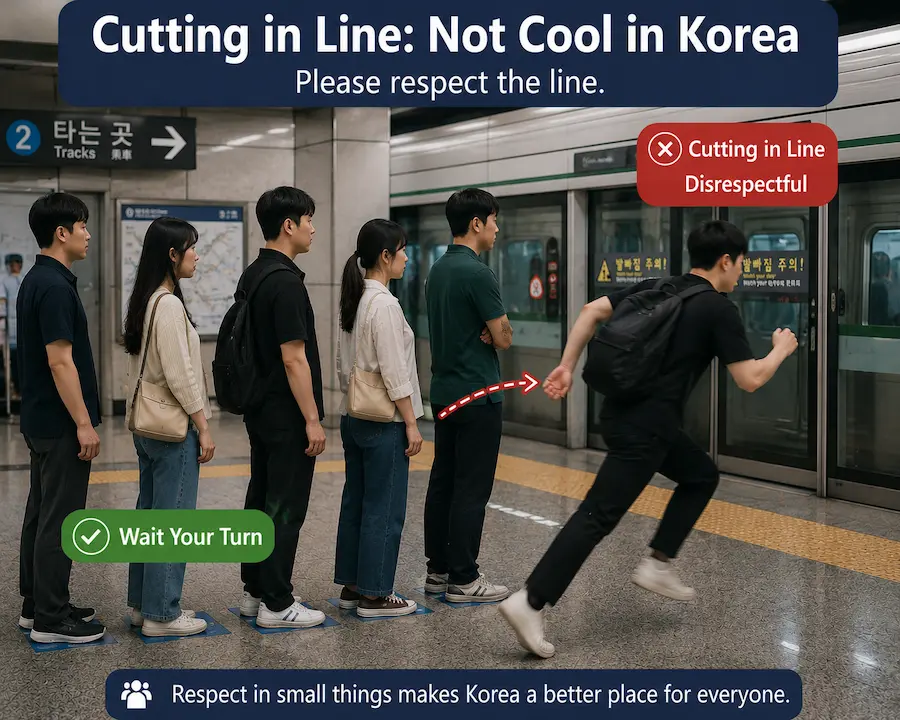
One of the fastest ways to make a bad impression in Korea—and one of the most common Korean etiquette mistakes that foreigners make—is cutting in line.
In Korea, waiting your turn is considered basic courtesy. Whether you’re taking the subway, boarding a bus, using an elevator, or even standing on an escalator, people are generally expected to line up in an orderly manner.
If you’ve never used the Korean subway before, you’ll quickly notice the clearly marked waiting areas on the platform. The rules are simple:
✔ Wait your turn
✔ Let passengers exit first
✔ Board in an orderly manner
Even during rush hour, when stations are packed with commuters, most people patiently wait in line.
Trying to squeeze ahead of others or rushing onto the train before passengers have exited will almost certainly earn you a few annoyed looks.
Many visitors are surprised by how organized Korean public transportation is. Thousands of people pass through major stations every hour, yet the system runs smoothly because most people follow the same unwritten rules of Korean etiquette.
For Koreans, waiting in line isn’t just about staying organized—it’s also a way of showing respect for other people’s time and personal space. Someone who cuts in line may be seen as putting their own convenience ahead of everyone else’s.
Even if nobody says anything, people will definitely notice.
🔇 2. Being Loud on Public Transportation
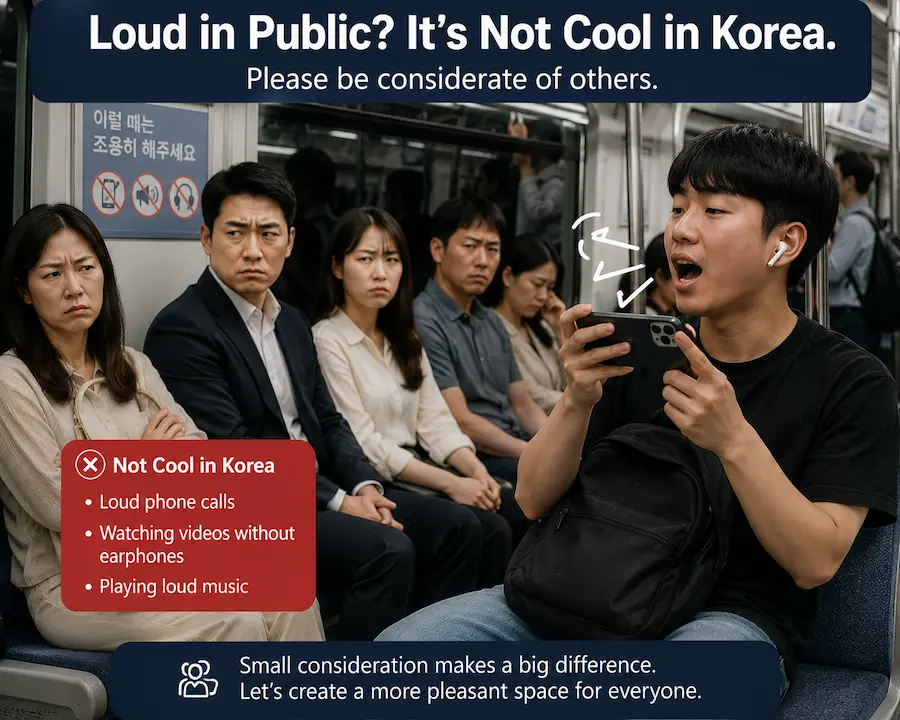
If you’ve never ridden a Korean subway before, one thing may surprise you:
It’s incredibly quiet.
Many commuters use their travel time to rest, study, read, listen to music with headphones, or simply relax after a long day.
Because of this, loud conversations, speakerphone calls, and videos played without headphones are considered very disruptive.
One of the most common complaints these days is people watching TikTok, Instagram Reels, or YouTube Shorts at full volume.
A few seconds of loud audio might not seem like a big deal, but in a quiet subway car, everyone can hear it.
This can feel quite different from some Western countries, where phone calls and louder conversations on public transportation are more common.
In Korea, public transportation is often seen as a shared resting space. Many people wake up early, work long hours, and spend a significant amount of time commuting.
As a result, people generally try to keep noise to a minimum and avoid disturbing those around them. Being mindful of the atmosphere is considered a sign of good manners and respect for others.
Your fellow passengers will appreciate it.
💡 Local Tip
Before boarding a bus or subway, switch your phone to silent mode and use headphones whenever possible.
🗣️ 3. Using Casual Language (Banmal) Too Quickly
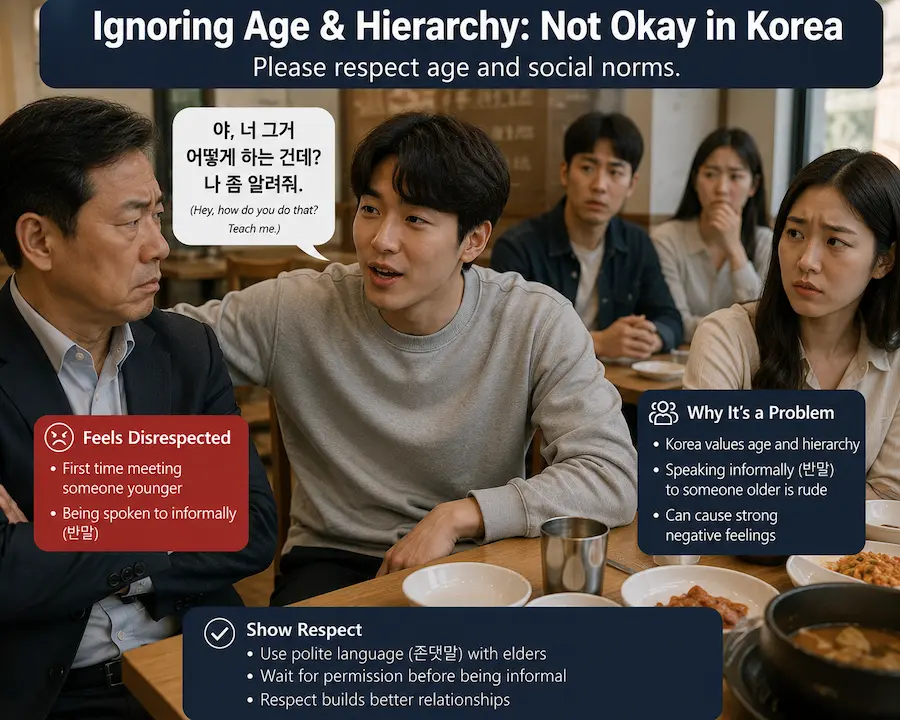
Respect for age and seniority is deeply rooted in Korean culture, and that respect is reflected in the language people use every day.
In general, Korean speech can be divided into two styles:
✔ 존댓말 (Jondaetmal) – polite speech
✔ 반말 (Banmal) – casual speech
Many foreigners first learn Korean through K-dramas, variety shows, or social media.
The problem is that the language used between close friends on TV doesn’t always work in real life.
Using expressions such as:
- “야!” (Hey!)
- “너” (You)
- Casual verb endings
when speaking to strangers, restaurant staff, taxi drivers, or older people can come across as surprisingly rude.
The good news is that Koreans do not expect foreigners to speak perfect Korean.
In fact, speaking polite English is often better than accidentally using impolite Korean.
This mistake is especially common because Korean entertainment can create a somewhat unrealistic picture of everyday communication. In dramas and movies, friends, classmates, and romantic partners often use Banmal with each other.
However, those relationships have already been established.
In real life, most Koreans begin with polite language and gradually switch to casual speech only after both people feel comfortable with each other.
💡 Local Tip
If you’re ever unsure which form to use, it’s always better to be a little too polite than too casual. Most Koreans will appreciate the effort and won’t mind if your Korean sounds overly formal.ual.
🚭 4. Smoking While Walking (Gil-Bbang)
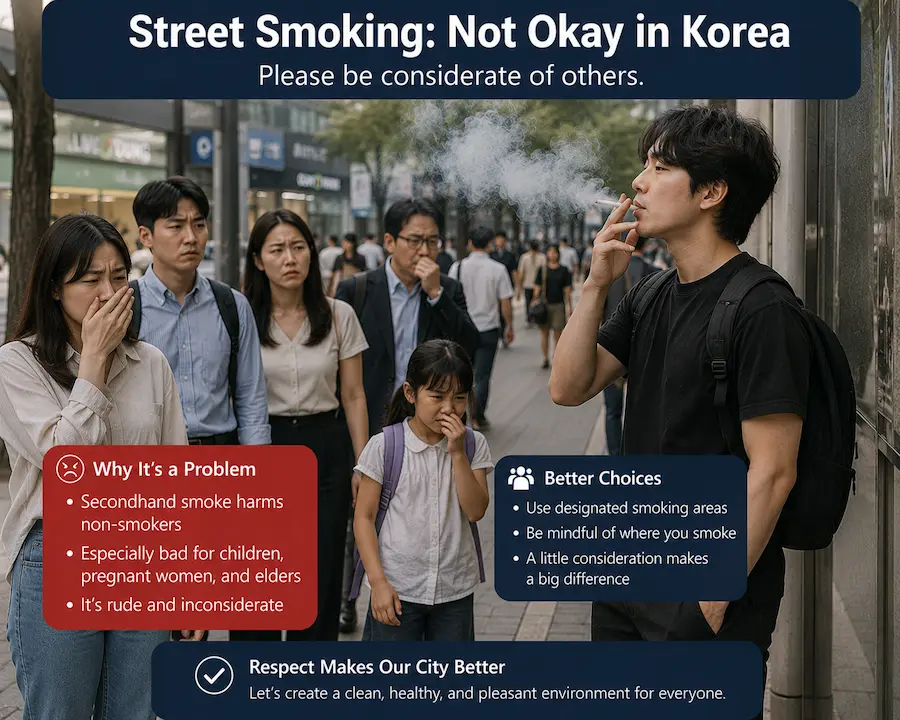
One of the most controversial habits in Korea is something called “Gil-Bbang” (길빵).
The term refers to smoking while walking down the street.
Many Koreans strongly dislike this behavior because the smoke often drifts directly into the faces of people walking nearby or behind the smoker.
Families with children, elderly people, and non-smokers tend to find it especially unpleasant.
Korea also has strict no-smoking zones, including areas near:
✔ Bus stops
✔ Subway entrances
✔ School zones
✔ Public facilities
Ignoring these rules can result in a fine.
😆 Here’s the Funny Part
You may notice groups of people smoking outside restaurants, bars, convenience stores, or nightlife areas.
And surprisingly, many locals simply accept it.
Yes, it’s a little confusing! 😆
As long as people remain in one place and stay outside designated no-smoking zones, this behavior is often socially tolerated.
Many foreigners find this contradiction confusing.
Walking while smoking is heavily criticized, yet standing outside a restaurant with a cigarette is often accepted.
From a Korean perspective, the issue isn’t always the smoking itself. The bigger concern is whether your smoke is affecting people who are simply trying to go about their day.
In other words, consideration for others matters more than personal convenience.
If you need a cigarette, look for a designated smoking area or stand in a spot where local smokers are already gathered. Doing so will help you avoid uncomfortable situations and show respect for the people around you.n area where local smokers are already gathered.
💡 Local Tip
Avoid smoking while walking.
If you need a cigarette, look for a designated smoking area or stand in a spot where local smokers are already gathered. Doing so will help you avoid uncomfortable situations and show respect for the people around you.
🍽️ 5. Calling Restaurant Staff Disrespectfully
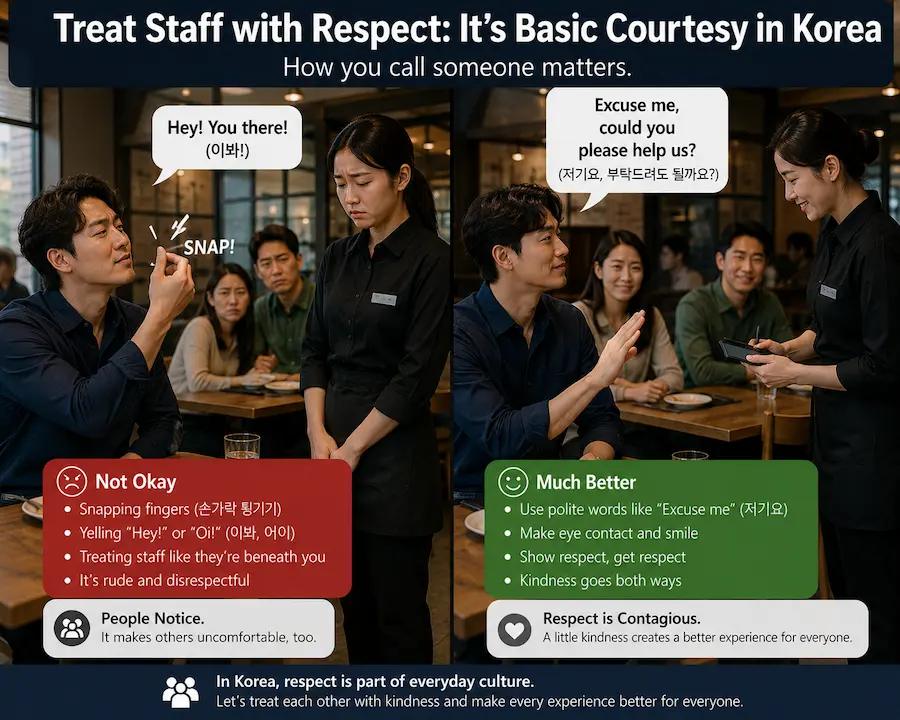
Service culture in Korea can be very different from what many foreigners are used to.
In some countries, snapping your fingers, shouting across the room, or aggressively waving at a server may be considered normal.
In Korea, however, these behaviors are generally seen as rude.
Actions that people usually dislike include:
❌ Snapping your fingers
❌ Shouting “Hey!” or “Oi!”
❌ Speaking to staff as if they are beneath you
So, what’s the proper way to get a server’s attention?
🔔 Use the Table Bell
Many Korean restaurants have a small call button right on the table.
Simply press the button, and a staff member will come over when they’re available.
🙋 Say “Jeogi-yo” (저기요)
If there isn’t a call button, politely raise your hand and say:
“저기요 (Jeogi-yo)”
It roughly means:
“Excuse me.”
It’s simple, polite, and understood everywhere in Korea.
Another reason disrespectful behavior feels particularly rude in Korea is that restaurant staff are generally viewed as professionals doing their job, not personal servants.
Many restaurant employees work long hours in fast-paced environments, especially during lunch and dinner rushes.
Because of this, treating staff with respect is considered basic courtesy, regardless of their position.
A friendly smile and a simple “Jeogi-yo” will almost always get a better response than shouting or making aggressive gestures.
If you’re planning to dine out in Korea, be sure to read our guide to Korean restaurant culture and dining etiquette to avoid common mistakes and enjoy a smoother dining experience.
10 Things Foreigners Find Shocking in Korean Restaurants
💡 Local Tip
Korean restaurant staff generally prefer direct but respectful communication.
You don’t need to be overly formal—just be polite.
If you’re planning to dine out in Korea, be sure to read our guide to Korean restaurant culture and dining etiquette to avoid common mistakes and enjoy a smoother dining experience.
❓ Frequently Asked Questions
Q.Is it okay to talk on the phone on the subway in Korea?
It’s not illegal, but loud phone calls are generally considered inconsiderate. Most people keep conversations short and speak quietly on public transportation.
Q.Can foreigners use Banmal (casual Korean) with strangers?
It’s better not to. When speaking to someone you don’t know, using polite language is always the safer choice.
Q.Are there designated smoking areas in Korea?
Yes. Many cities have designated smoking zones, and smoking in restricted areas can result in a fine.
Q.How should I call a server in a Korean restaurant?
If there isn’t a table bell, simply say “Jeogi-yo” (저기요), which means “Excuse me.” Avoid snapping your fingers or shouting across the room.
Q.What happens if I accidentally break an etiquette rule in Korea?
Usually, nothing serious. Most Koreans understand that visitors may not know every social custom. Showing respect and being considerate of others matters far more than being perfect.
🎯 Final Thoughts
At its core, Korean etiquette is all about respecting the people around you.
Whether it’s waiting your turn, keeping your voice down, or speaking politely, these small actions help maintain harmony in shared spaces.
The good news is that Koreans don’t expect foreigners to be perfect. Most people appreciate a genuine effort to understand local customs.
Cultural mistakes happen to everyone, and making a few along the way is completely normal.
What matters most is showing consideration, patience, and respect for others.
If you approach Korea with curiosity and an open mind, you’ll quickly discover one of the country’s greatest strengths: the warmth and kindness of its people.
Avoid these common etiquette mistakes, and your experience in Korea will likely be smoother, more enjoyable, and filled with positive interactions. 🇰🇷✨
📚 Related Korea Living Guides
8 Essential Apps Every Foreigner Needs in Korea
10 Things Foreigners Find Shocking in Korean Restaurants