Jeju car rental for foreigners can be the easiest and most convenient way to explore the island.
Unlike Seoul, Jeju has limited public transportation options, making a rental car the preferred choice for many international visitors.
Many first-time visitors arrive expecting Korea’s excellent public transportation system to make exploring the island easy. While buses and taxis are available, Jeju’s attractions are spread across the island, and public transportation often requires long travel times and multiple transfers.
For that reason, renting a car is often the most convenient, flexible, and time-efficient way to explore Jeju. It allows you to travel on your own schedule, visit more destinations in a single day, and enjoy the island without being limited by bus routes or taxi availability.
In this guide, you’ll learn everything you need to know about renting a car in Jeju, including required documents, International Driving Permit (IDP) requirements, insurance options, fuel types, pickup and return tips, and common mistakes that foreign travelers should avoid.
🌴 Why Renting a Car in Jeju Is a Must
While Seoul is famous for its extensive subway system and convenient public transportation, Jeju Island is a completely different experience.
🚇 No Subway or Train System
Unlike Seoul, Jeju has no subway or railway network. Public transportation on the island relies entirely on buses and taxis, which can make traveling between attractions much more time-consuming.
🚌 Limited Bus Schedules
Although buses cover most parts of the island, they do not run as frequently as many visitors expect. In some areas, especially rural villages and mountain regions, buses may arrive only once every 30 minutes to an hour or even less frequently.
Missing a bus can easily disrupt your schedule and reduce the amount of sightseeing you can fit into a single day.
📍 Attractions Are Spread Across the Island
One of the biggest challenges for travelers is the distance between Jeju’s major attractions.
Popular destinations such as Seongsan Ilchulbong (Sunrise Peak), Hyeopjae Beach, Seogwipo, and Aewol are located in different parts of the island. Traveling between these locations by bus often requires multiple transfers and significantly longer travel times.
⏳ Make the Most of Your Time in Jeju
Most visitors only spend a few days on Jeju Island. Instead of waiting for buses or planning your day around public transportation schedules, a rental car allows you to travel freely and explore more of the island at your own pace.
For most foreign travelers, renting a car is the easiest, fastest, and most convenient way to experience Jeju Island. It gives you the flexibility to visit hidden attractions, stop whenever you want, and make the most of your vacation.
💰 Taxi, Bus, or Rental Car: Which Option Makes the Most Sense?
Many first-time visitors assume that using taxis or public transportation will save money during their trip to Jeju.
In reality, once you consider transportation costs, waiting times, and overall convenience, a rental car is often the most practical option for exploring the island.
📊 Quick Comparison: Taxi vs. Bus vs. Rental Car
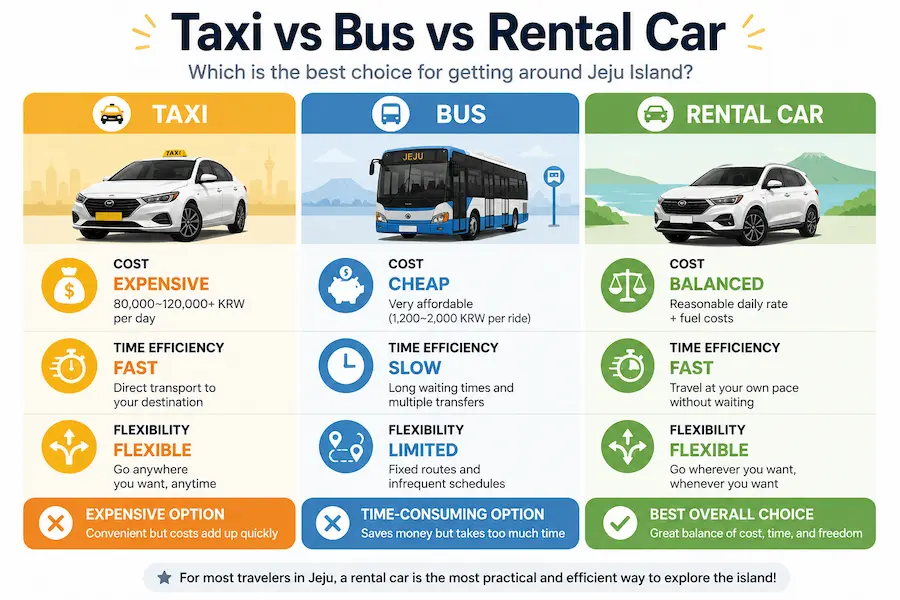
🚕 How Expensive Are Taxis in Jeju?
At first glance, taxis may seem like a convenient option. However, costs can add up surprisingly quickly.
For example, a round-trip taxi ride between Jeju City and Seogwipo can easily cost 80,000 KRW or more.
If you add shorter rides throughout the day—such as traveling between restaurants, cafes, beaches, and tourist attractions—your daily transportation expenses can easily exceed 100,000 KRW (approximately $70 USD).
For many travelers, that amount is enough to cover the daily cost of a compact rental car plus fuel.
Another factor many visitors overlook is taxi availability. While finding a taxi is usually easy in downtown areas, it can be much more difficult near remote beaches, scenic viewpoints, hiking trails, and smaller tourist attractions.
In some locations, you may have to wait a long time for an available taxi, and in certain remote areas, it may be difficult to find one at all. During weekends, public holidays, and peak travel seasons, wait times can become significantly longer, especially at popular tourist spots.
For travelers planning to visit multiple attractions across the island, relying entirely on taxis can quickly become both expensive and inconvenient.
🚌 The Hidden Cost of Using Public Transportation
Buses are the cheapest transportation option in Jeju, but they come with a significant trade-off: time.
Unlike Seoul, bus schedules in Jeju are often less frequent, especially in rural areas and around popular tourist attractions.
Many visitors underestimate how much time they spend:
✔ Waiting for buses
✔ Finding the correct routes
✔ Making transfers
✔ Walking from bus stops to attractions
It’s not unusual to lose 2 to 3 hours per day simply waiting for or transferring between buses.
When you’re only visiting Jeju for a few days, those lost hours can significantly impact your overall travel experience.
🚗 Why a Rental Car Is the Best Choice
For most foreign travelers, renting a car offers the best balance of cost, convenience, and flexibility.
With a rental car, you can:
✅ Visit multiple attractions in a single day
✅ Avoid waiting for buses
✅ Travel comfortably with luggage, strollers, or shopping bags
✅ Explore hidden beaches, cafes, and scenic spots that are difficult to reach by public transportation
✅ Travel on your own schedule without worrying about bus timetables
While a rental car may cost more than taking the bus, it is often cheaper than relying on taxis and provides a significantly better travel experience.
🎯 Transportation Verdict
The infographic above highlights the key differences between taxis, buses, and rental cars in Jeju.
If your goal is to explore as much of the island as possible while making the most of your vacation time, here’s the simple takeaway:
🚕 Taxi — Convenient, but transportation costs can add up quickly.
🚌 Bus — Budget-friendly, but often requires extra travel time and multiple transfers.
🚗 Rental Car — The best balance of cost, convenience, flexibility, and time efficiency.
For most visitors staying more than one day in Jeju, renting a car is usually the smartest and most practical transportation choice.
📄 Can Foreigners Drive in Korea? Documents You Must Bring
Before picking up your rental car in Jeju, make sure you have all the required documents.
Many foreign travelers are surprised to learn that missing or incorrect documents can result in an immediate rental denial, even if they have already paid for their reservation.
✅ Required Documents Checklist
| Document | Required? | Notes |
|---|---|---|
| 🪪 International Driving Permit | ✅ Yes | Must be issued under the 1949 Geneva Convention |
| 🚗 Original Driver’s License | ✅ Yes | Physical card only |
| 🛂 Passport | ✅ Yes | Must match your IDP and driver’s license |
| 📱 Digital Copies | ❌ No | Not accepted by most rental companies |
🪪 International Driving Permit (1949 Geneva Convention)
The most important requirement is a valid International Driving Permit (IDP).
South Korea only recognizes International Driving Permits issued under the 1949 Geneva Convention.
⚠️ Important: If your country issues an IDP under the 1968 Vienna Convention, some rental companies may refuse to rent you a vehicle. Always check your IDP carefully before traveling to Korea.
Before your trip, verify that your IDP is valid and accepted in South Korea.
🛂 Bring Your Original Driver’s License and Passport
An International Driving Permit is not considered a standalone driver’s license.
You must also present:
✅ Your original driver’s license
✅ Your physical passport
Rental companies use these documents to verify your identity and driving eligibility.
Digital copies, screenshots, and photocopies are generally not accepted.
⚠️ Make Sure Your Name Matches on All Documents
This is a surprisingly common issue for international travelers.
The English spelling of your name should match across:
• Passport
• International Driving Permit
• Driver’s License
Even small differences involving hyphens, spaces, middle names, or surname order can create verification problems at the rental counter.
To avoid delays, double-check all documents before departure.
🚐 The 9-Seater vs. 11-Seater License Trap
Many families and group travelers assume that any passenger van can be driven with a standard driver’s license.
However, vehicle size matters.
📊 International License Class Comparison
| License Class | Allowed Vehicles | Typical Example |
|---|---|---|
| Class B | Up to 8 passenger seats (excluding driver) | Sedan, SUV, 9-Seater Carnival |
| Class D | More than 8 passenger seats | 11-Seater Van, Large Passenger Vehicles |
Because of these regulations, some travelers arrive in Jeju expecting to drive an 11-seater vehicle only to discover that their license class does not allow it.
⚠️ Driving an 11-seater vehicle without the appropriate license class may be treated as unlicensed driving under Korean law.
💡 Travel Tip for Families
If you hold a standard driver’s license and a Class B International Driving Permit, choosing a 9-seater Kia Carnival is usually the safest option.
It offers:
✅ Plenty of luggage space
✅ Comfortable seating for families
✅ Compatibility with most standard International Driving Permits
Before completing your reservation, always verify the exact seating capacity of the vehicle to avoid unexpected issues at pickup.
🛡️ Understanding Rental Car Insurance in Jeju
Rental car insurance can be one of the most confusing parts of renting a vehicle in Korea.
Before booking your car, it’s important to understand the differences between insurance options. The cheapest plan is not always the safest choice, and the coverage details can vary significantly between rental companies.
📊 Rental Car Insurance Comparison
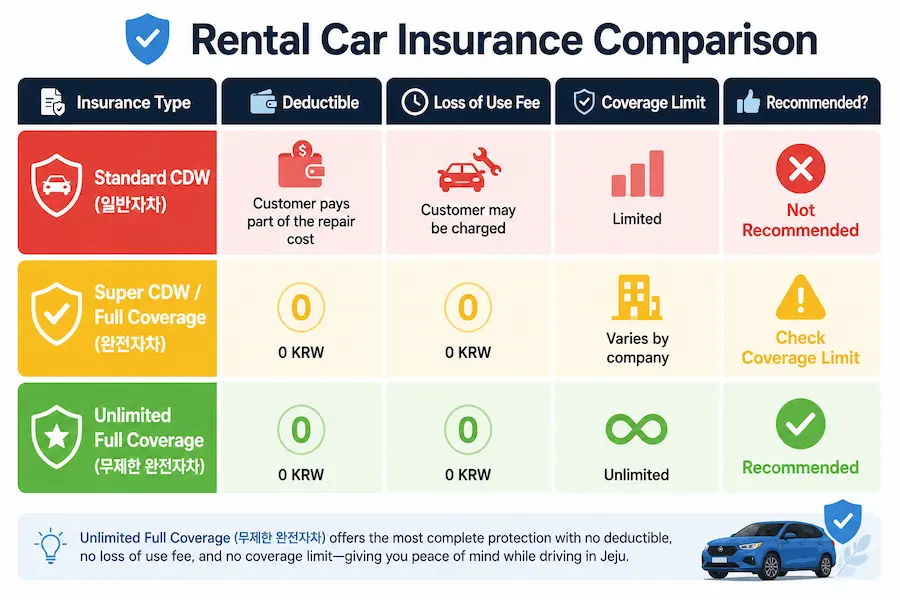
🚧 Standard CDW: The Hidden Costs
Standard CDW is usually the cheapest insurance option.
While it reduces your financial responsibility for repair costs, it often does not eliminate all expenses.
One important charge to be aware of is the Loss of Use Fee (휴차보상료).
If the rental vehicle is damaged and requires repairs, the rental company may charge you for the income lost while the vehicle is unavailable for other customers.
Depending on the repair period, these additional costs can become significant.
For this reason, many travelers choose a higher level of coverage for added peace of mind.
⚠️ Full Coverage Does Not Always Mean Unlimited Coverage
Many travelers assume that “Full Coverage” or “Super CDW” automatically means complete protection.
However, coverage limits vary by rental company.
Some budget rental companies offer Full Coverage plans that include:
✅ 0 KRW deductible
✅ No Loss of Use Fee
But they may still limit the maximum amount the insurance will pay.
For example, if the coverage limit is 3,000,000 KRW and accident-related costs reach 10,000,000 KRW, you may still be responsible for the remaining amount.
Before confirming your reservation, always check the maximum coverage limit listed in the insurance policy.
✅ Why Unlimited Full Coverage Is Often the Best Choice
Major rental companies such as Lotte Rent-a-Car and SK Rent-a-Car often offer an insurance option known as Unlimited Full Coverage.
With this type of coverage:
✅ 0 KRW deductible
✅ No Loss of Use Fee
✅ No coverage limit
This means you are protected against most unexpected costs following an accident.
Although Unlimited Full Coverage typically costs more than basic insurance plans, many international visitors consider the extra cost worthwhile for the added security and convenience.
💡 Recommended Option for Most Foreign Travelers
If your budget allows, choose Unlimited Full Coverage whenever available.
The difference in price is often relatively small compared to the potential cost of an accident, and it can make your trip significantly less stressful.
⛽ Choosing the Right Fuel Type
Rental cars in South Korea are typically available in three fuel types:
• Gasoline
• Diesel
• LPG (Liquefied Petroleum Gas)
While gasoline and diesel vehicles are familiar to most travelers, LPG vehicles can be confusing for visitors who have never used them before.
Before booking your rental car, it’s worth understanding the pros and cons of each option.
🚗 Gasoline and Diesel Cars
Gasoline and diesel vehicles are the most common and convenient choices for foreign travelers.
Benefits include:
✅ Easy refueling at almost any gas station in Korea
✅ No restrictions on trunk space
✅ Familiar driving experience for most visitors
✅ Ideal for families carrying multiple suitcases, golf bags, strollers, or shopping bags
For most travelers visiting Jeju, gasoline or diesel vehicles offer the simplest and most hassle-free experience.
💸 LPG Cars: Cheaper Fuel, Bigger Trade-Offs
LPG vehicles are popular in Korea because fuel prices are generally lower than gasoline or diesel.
👍 Advantages of LPG Vehicles
✅ Lower fuel costs
✅ Good option for travelers planning long driving distances
✅ Often available at lower rental rates
For budget-conscious travelers, LPG vehicles can help reduce overall transportation costs.
⚠️ Drawback #1: Reduced Trunk Space
One of the biggest disadvantages of many LPG vehicles is reduced luggage space.
Because the LPG fuel tank is typically installed inside the trunk area, available cargo space is often noticeably smaller than in comparable gasoline or diesel models.
If you’re traveling with:
• Multiple large suitcases
• Golf bags
• Baby strollers
• Family luggage
you may find trunk space more limited than expected.
⚠️ This is especially important for families, golfers, and travelers carrying several large suitcases.
In some cases, luggage may need to be placed inside the passenger cabin instead of the trunk.
⚠️ Drawback #2: Fewer LPG Stations
Unlike gasoline or diesel, LPG cannot be refueled at every gas station.
You must use dedicated LPG stations.
While LPG stations are available throughout Jeju, they are generally less common than regular gas stations, especially in smaller towns and rural areas.
If you choose an LPG vehicle, it’s a good idea to locate nearby LPG stations before starting a long drive around the island.
🎒 Which Fuel Type Is Best for Travelers?
For most foreign visitors, a gasoline or diesel vehicle is usually the best choice.
While LPG vehicles can help reduce fuel expenses, the smaller trunk space and more limited refueling options may outweigh the savings for many travelers.
If you’re traveling with:
✅ Family members
✅ Large suitcases
✅ Golf equipment
✅ A baby stroller
✅ Shopping bags
a gasoline or diesel vehicle will generally provide a more comfortable and convenient travel experience.
💡 Quick Recommendation
🚗 Traveling with family or lots of luggage? → Choose Gasoline or Diesel
💸 Traveling on a tight budget with minimal luggage? → Consider LPG
For most visitors to Jeju, gasoline or diesel remains the safest and most practical choice.
📱 What About Navigation Apps?
Many first-time visitors worry about navigation when driving in Jeju.
Fortunately, most modern rental cars in Korea support Apple CarPlay and Android Auto, making navigation much easier than many travelers expect.
Simply connect your smartphone to the vehicle, and you can use navigation apps directly on the car’s display screen.
Many foreign visitors use Naver Map or Kakao Navi in English, which provide accurate directions, real-time traffic updates, and reliable route guidance throughout Jeju Island.
👉 Before your trip, check out our guide to Naver Map vs. KakaoMap vs. TMAP to find the best navigation app for driving in Korea.
⏰ Smart Pickup and Return Timing Tips
One of the most common mistakes travelers make in Jeju is scheduling their rental car pickup and return times too close to their flight schedule.
Even small delays at the airport can affect your plans, so it’s always a good idea to leave some extra time before pickup and return.
✈️ Best Pickup Time After Landing
A simple rule is:
📍 Pickup Time = Flight Arrival Time + 1 Hour
For example, if your flight lands at 10:00 AM, consider setting your rental car pickup time for 11:00 AM.
After landing, you’ll need time to:
✅ Exit the aircraft
✅ Collect checked baggage
✅ Walk to the Rental Car House
✅ Find the correct shuttle bus
✅ Complete the rental paperwork
Even on a smooth travel day, this process often takes 40 to 60 minutes.
If your flight is delayed or baggage claim takes longer than expected, a little extra buffer time can make the start of your trip much less stressful.
🛫 When Should You Return Your Rental Car?
Another useful rule is:
📍 Return Time = Flight Departure Time – 2 Hours
For example, if your flight departs at 6:00 PM, aim to return your vehicle by 4:00 PM.
Many visitors assume they can return the car shortly before their flight, but there are several steps involved before reaching the airport terminal.
🚦 Why Returning Early Matters
🚗 Traffic Delays
Roads around Jeju Airport can become busy during weekends, holidays, and peak travel periods.
Unexpected traffic can easily add extra travel time.
🏢 Rental Car Return Process
Most rental companies operate from locations outside the airport.
After arriving at the return office, staff will inspect the vehicle, check fuel levels, and complete the return process.
🚌 Shuttle Bus Transfer
Once your vehicle is returned, you’ll need to board the company’s shuttle bus back to the airport.
Depending on traffic and shuttle schedules, this can take additional time.
🛂 Airport Check-In and Security
After arriving at the airport, you’ll still need to:
✅ Check in for your flight
✅ Drop off checked baggage
✅ Pass through security screening
✅ Walk to your departure gate
During busy travel periods, lines can be longer than expected.
💡 Recommended Timing
To avoid unnecessary stress, many experienced travelers follow these guidelines:
✈️ Flight Arrival + 1 Hour = Rental Car Pickup
🛫 Flight Departure – 2 Hours = Vehicle Return
Following these simple rules will give you enough flexibility to handle unexpected delays and help ensure a smoother start and finish to your Jeju trip.
💡 Money-Saving Tip
Most rental car companies in Jeju calculate their rates based on the exact rental period. Before making a reservation, carefully choose your pickup and return times, as even a small adjustment can affect the total rental cost.
For example, scheduling your pickup one hour after your flight arrives and returning the vehicle at least two hours before departure can help you avoid unnecessary stress while making the most of your rental period.
A little planning can save both time and money during your trip.
🏢 Major Rental Brands vs. Local Rental Companies
Jeju has a wide range of rental car companies, from well-known national brands to smaller local operators.
The best choice depends on your budget, insurance preferences, and how comfortable you are communicating in Korea.
📊 Quick Comparison
| Feature | Major Brands | Local Rental Companies |
|---|---|---|
| Price | Higher | Lower |
| English Support | Good | Limited |
| Insurance Options | More Comprehensive | Varies by Company |
| Vehicle Condition | Generally Consistent | Varies by Company |
| Convenience | Excellent | Good |
| Best For | First-Time Visitors | Budget Travelers |
⭐ Major Brands: Lotte Rent-a-Car & SK Rent-a-Car
Major rental companies such as Lotte Rent-a-Car and SK Rent-a-Car are often the easiest option for foreign travelers.
Benefits include:
✅ English-language booking websites
✅ Better English support at rental counters
✅ Clear insurance options
✅ Consistent customer service
✅ Well-maintained vehicle fleets
The main downside is price. Rental rates are often higher than those offered by smaller local companies.
However, many first-time visitors find the extra cost worthwhile for the added convenience and peace of mind.
💰 Budget-Friendly Local Rental Companies
Local rental companies can often offer significantly lower prices than major brands.
Many travelers use comparison platforms such as:
✅ Jeju Pass
✅ Dolharupang
These services allow you to compare prices from multiple local rental companies and often provide some of the best deals available on the island.
However, there are a few things to keep in mind:
⚠️ English support may be limited
⚠️ Insurance coverage can vary between companies
⚠️ Rental policies may differ from one provider to another
For experienced travelers looking to save money, local rental companies can be an excellent option.
📱 Download Papago Before Your Trip
If you decide to book through a local rental company, downloading Papago before your trip is highly recommended.
Papago is one of Korea’s most popular translation apps and can be extremely helpful when:
✅ Reading rental agreements
✅ Asking questions at the rental counter
✅ Understanding vehicle instructions
✅ Communicating with local staff
Even if you choose a major rental company, having a translation app on your phone can make traveling in Korea much easier.
💡 Our Recommendation
For first-time visitors to Jeju, Lotte Rent-a-Car or SK Rent-a-Car are usually the safest and most convenient choices.
If you’re comfortable using translation apps and want to save money, local rental companies can offer excellent value.
The most important thing is to compare insurance coverage carefully—not just the rental price.
🚗 How to Pick Up Your Rental Car at Jeju Airport
Unlike many airports around the world, rental cars in Jeju are not picked up directly outside the terminal building.
Instead, you’ll need to take a shuttle bus from the airport to your rental company’s office.
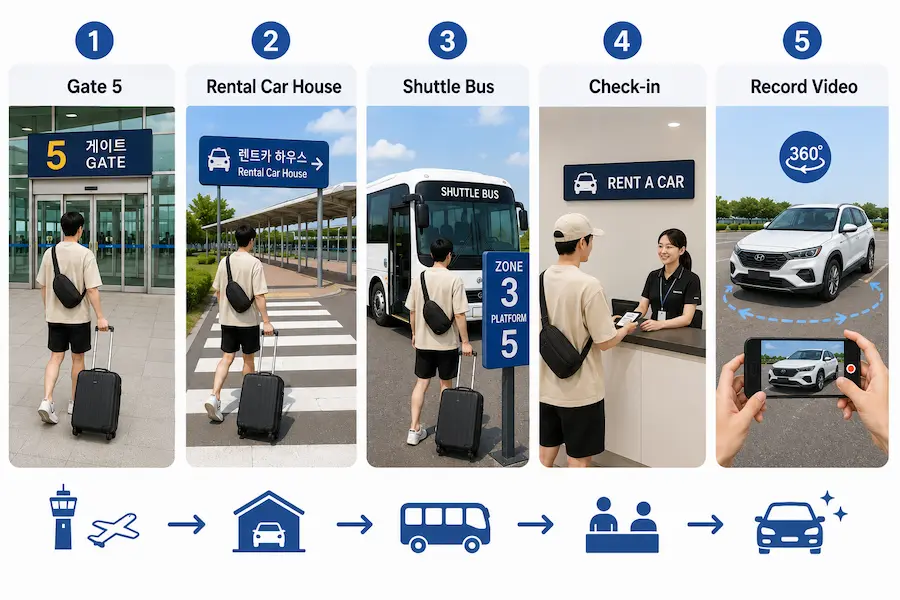
📍 The infographic below shows the entire pickup process step by step.
1️⃣ Exit Through Gate 5
After collecting your luggage, head to Gate 5 in the arrivals area and exit the terminal.
2️⃣ Walk to the Rental Car House
Cross the street and follow the signs for the Rental Car House (렌트카 하우스).
The walk usually takes around 3 to 5 minutes.
3️⃣ Find Your Shuttle Bus
Check your reservation confirmation for your assigned shuttle zone and platform number.
Once you find the correct shuttle bus, board it and travel to your rental company’s office.
4️⃣ Complete Check-In
At the rental office, present:
✅ Passport
✅ International Driving Permit (IDP)
✅ Original Driver’s License
You can usually check in at a self-service kiosk or rental counter.
5️⃣ Record a Quick Inspection Video
Before driving away, take a 360-degree video of the vehicle.
Be sure to record:
✅ Tire rims
✅ Front bumper
✅ Existing scratches or dents
✅ Fuel level
This simple step can help prevent misunderstandings about pre-existing damage when you return the vehicle.
💡 Important Tip
Many travelers skip the inspection process because they are excited to start their trip.
However, spending just a few minutes recording the vehicle’s condition can save you time, money, and unnecessary disputes later.
A quick video before departure is one of the easiest ways to protect yourself during your rental period.
🎯 Final Verdict
For most travelers, the answer is yes.
While buses and taxis are available, a rental car offers the best combination of convenience, flexibility, and time savings when exploring Jeju Island.
By preparing the required documents, choosing suitable insurance coverage, selecting the right vehicle, and planning your pickup and return times carefully, you can avoid many of the common issues that first-time visitors face.
A rental car allows you to travel at your own pace, visit multiple attractions in a single day, and make the most of your time on the island.
If you’re planning to explore more than just Jeju City, renting a car is often the most practical and enjoyable way to experience Jeju.
📚 Related Korea Living Guides:
Buying a SIM Card or eSIM for Korea?
WOWPASS vs NAMANE Card: Which Is Better for Korea Travel?
8 Essential Apps Every Foreigner Needs in Korea