Housing Deposit in Korea is one of the most important things foreigners should understand before renting a home in South Korea.
Finding a place to live is one of the first major challenges that international students, expats, digital nomads, and working holiday travelers face after arriving in Korea.
Unlike many Western countries, renting a won-room or officetel in Korea usually requires a large security deposit known as Bojeunggeum (보증금).
Even for a standard monthly rental contract (Wolse), deposits of ₩5,000,000 to ₩10,000,000 are common, and properties in popular areas may require significantly more.
For many foreigners, this deposit represents the largest single payment they will make during their stay in Korea.
Naturally, one question follows:
“How can I make sure I get my deposit back safely?”
Unfortunately, many newcomers are unfamiliar with Korea’s unique housing system. This can lead to overpaid broker fees, misunderstandings during lease negotiations, or even rental scams involving unreturned deposits.
The good news is that South Korea provides strong legal protections for tenants.
By understanding how the rental system works and completing a few important procedures after moving in, you can significantly reduce your financial risk and better protect your deposit.
💰 Understanding Real Estate Broker Fees (Bokbi)
In Korea, the fee paid to a licensed real estate agent is commonly called Bokbi (복비).
Many foreigners assume they must pay whatever amount the agent requests. Fortunately, this is not the case.
Broker fees are regulated by Korean law, and licensed agents can only charge up to the legal maximum rate based on the transaction amount.
Understanding how these fees are calculated can help you avoid overpaying and ensure that you are being charged fairly.
📊 Monthly Rent Calculation Formula
For Wolse (monthly rent) contracts, Korea uses a Converted Transaction Amount formula to determine the legal broker fee.
| Formula | Calculation |
|---|---|
| Standard Formula | Deposit + (Monthly Rent × 100) |
| If Result Is Below ₩50,000,000 | Deposit + (Monthly Rent × 70) |
This adjusted formula helps protect lower-value rental contracts by reducing the calculated transaction amount.
🧮 Example Calculation
Suppose you find a studio apartment with the following rental terms:
| Item | Amount |
|---|---|
| Deposit | ₩5,000,000 |
| Monthly Rent | ₩450,000 |
Calculation:
₩5,000,000 + (₩450,000 × 100)
= ₩50,000,000
Since the converted transaction amount is ₩50,000,000, the legal broker fee is calculated using the government fee table.
✅ Before You Sign
Before paying any broker fee:
✔ Ask for a fee breakdown
✔ Check the Property Description Report (중개대상물 확인설명서)
✔ Request an official receipt
✔ Verify that the fee matches the legal rate
Taking a few minutes to verify the numbers can help you avoid unnecessary costs and potential misunderstandings..
🧾 How to Avoid Broker Fee Scams
Most licensed real estate agents in Korea are trustworthy, but misunderstandings and overcharging can still happen, especially when foreign tenants are unfamiliar with local regulations.
Fortunately, there are several simple ways to protect yourself and make sure you are paying the correct broker fee.
📄 Check the Property Description Report
When signing a lease, the real estate agent is legally required to provide a document called the Property Description Report (중개대상물 확인설명서).
This document contains important information about the property, including ownership details, building information, and the broker fee calculation.
Before signing, carefully review the final section of the report, where the brokerage fee and related expenses should be clearly listed.
🧾 Always Request an Official Receipt
After paying the broker fee, ask for an official receipt.
A receipt provides proof of payment and can help resolve disputes if questions arise later.
Avoid paying large amounts of cash without receiving written confirmation.
💳 Keep Your Bank Transfer Records
Whenever you transfer money for:
- Contract deposits
- Housing deposits
- Monthly rent
- Broker fees
save screenshots, bank statements, or transfer confirmations.
These records serve as valuable evidence if any payment-related issues occur in the future.
☎️ Use the 1330 Interpretation Service
If communication becomes difficult because of language barriers, call 1330, Korea’s free travel and interpretation hotline.
The service can provide real-time interpretation assistance and help you communicate with real estate agents, landlords, and local service providers.
✅ Quick Tip
Before paying any broker fee, verify the amount, request a receipt, and keep all payment records.
A few minutes of verification can save you from unnecessary expenses and potential disputes later.
🚨 Common Rental Scam Warning Signs in Korea
Most real estate transactions in Korea are safe, but rental scams do happen. Foreigners are sometimes more vulnerable because they may be unfamiliar with local housing practices, legal procedures, and rental terminology.
Before signing any lease agreement, watch out for these common warning signs.
🚩 The Rent Is Much Cheaper Than Similar Properties
If a room appears significantly cheaper than comparable listings in the same neighborhood, be cautious.
While genuine bargains do exist, scammers often use unusually low prices to attract tenants quickly and create a sense of urgency.
If a property seems too good to be true, take extra time to verify all information before transferring any money.
🚩 The Agent or Landlord Pressures You to Sign Immediately
Be careful if you hear phrases such as:
- “Another tenant is ready to sign today.”
- “You need to transfer the deposit immediately.”
- “This price is only available for a few hours.”
Legitimate landlords and licensed real estate agents understand that tenants need time to review contracts and ask questions.
🚩 The Landlord Is Difficult to Contact
If the landlord avoids direct communication, refuses to answer basic questions, or becomes difficult to reach during the negotiation process, consider it a warning sign.
When large deposits are involved, transparency is essential.
🚩 Money Is Requested Before Any Documentation
Never transfer a deposit simply because someone asks you to.
Before sending money, make sure you have:
✔ A written lease agreement
✔ The property’s full address
✔ Verified landlord information
✔ Clear payment instructions
Avoid situations where large sums of money are requested before any official paperwork is provided.
🚩 Important Promises Are Not Written in the Contract
If a landlord promises something verbally, ask for it to be included in the lease agreement.
This includes:
- Move-in dates
- Furniture and appliances
- Repair responsibilities
- Deposit return conditions
In Korea, written contracts provide far stronger protection than verbal agreements.
When in doubt, slow down, ask questions, and verify everything before signing.
A few extra minutes of verification can help you avoid costly mistakes and make your rental experience in Korea much safer.
🏘️ Jeonse vs Wolse: Which Is Better for Foreigners?
Many newcomers to Korea quickly come across the term Jeonse (전세), a unique housing system that is rarely found outside Korea.
Under a Jeonse contract, tenants provide a large lump-sum deposit to the landlord and pay little or no monthly rent during the lease period.
At first glance, this may seem like an attractive option. However, for most foreigners, Wolse (monthly rent) is usually the safer and more practical choice.
| Category | Jeonse | Wolse |
|---|---|---|
| Deposit | Very High | Lower |
| Monthly Rent | None or Very Low | Required |
| Financial Risk | Higher | Lower |
| Flexibility | Limited | Higher |
| Popular Among Foreigners | Less Common | Very Common |
Why Many Foreigners Prefer Wolse
1. Higher Deposit Risk
Jeonse requires a very large deposit, often tens or even hundreds of thousands of dollars.
If problems arise with the landlord, recovering such a large amount of money can become stressful and time-consuming.
2. Limited Financing Options
Many Korean citizens use government-backed Jeonse loans to finance their deposits.
Foreign residents generally have fewer financing options and may not qualify for the same lending programs.
3. Greater Flexibility
Many expats, students, and digital nomads face changing circumstances such as visa renewals, job changes, or relocation opportunities.
Wolse contracts typically require a smaller upfront investment and offer greater flexibility.
4. Reduced Exposure to Rental Scams
Although rental scams are relatively uncommon, recent years have seen several high-profile Jeonse fraud cases involving large housing deposits.
Because Wolse usually requires a much smaller deposit, the potential financial loss is often significantly lower.
The Bottom Line
Jeonse is a legitimate housing system and works well for many Korean residents.
However, for most foreigners who are unfamiliar with the Korean housing market, Wolse is usually the simpler, safer, and more flexible option.
📅 From Payment to Protection: The Essential Real Estate Timeline
Many renters ask:
“When should I pay the broker fee?”
“When do I get legal protection?”
The process is actually quite simple. The timeline below shows exactly what happens from signing a lease to securing legal protection for your housing deposit.
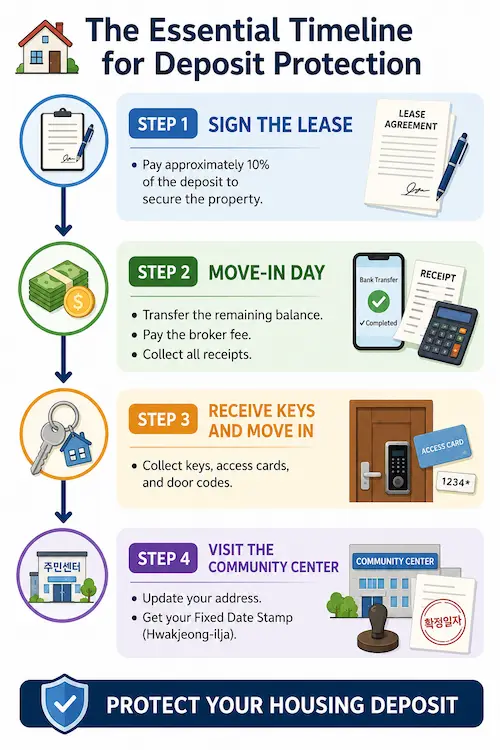
💡 Quick Tip for Foreign Renters
Many foreigners assume that their housing deposit is automatically protected once they sign a lease and move in. However, legal protection only becomes effective after completing the required administrative procedures.
The good news is that the process is simple. By following the timeline above, keeping all payment records, updating your address, and obtaining a Fixed Date Stamp (Hwakjeong-ilja), you can significantly reduce the risk of future disputes and better protect your housing deposit in Korea.
A few hours of preparation on move-in day can help safeguard thousands of dollars later.
🛡️Safeguard Your Deposit: Change of Residence & Fixed Date Stamp
After moving into your new home, there are two important steps you should complete as soon as possible.
These procedures help establish your legal status as a tenant and provide additional protection for your housing deposit.
📍 Step 1: Register Your New Address
Foreign residents in Korea are required to report their new address after moving.
Visit your local Community Center (주민센터) and bring:
- Passport
- Alien Registration Card (ARC)
- Original Lease Agreement
Updating your address officially records your residency at the property and helps protect your rights as a tenant.
📌 Step 2: Obtain a Fixed Date Stamp (Hwakjeong-ilja)
While visiting the Community Center, ask:
“Hwak-jeong-il-ja hae-ju-se-yo” (확정일자 해주세요)
A Fixed Date Stamp is an official government stamp placed on your lease agreement.
This stamp helps strengthen your legal protection and may give you priority when recovering your deposit if the landlord experiences financial difficulties or the property becomes subject to legal proceedings.
The cost is minimal, but the protection can be extremely valuable.
After receiving the stamp, store the original contract in a safe place and keep a digital backup for your records.
✅ Quick Tip
Many experienced renters complete both the address registration and Fixed Date Stamp process on the same day they move in.
Taking care of these steps immediately can save significant time, stress, and potential financial loss in the future.
📄 Documents Foreigners Should Always Keep
One of the easiest ways to protect yourself while renting in Korea is by keeping proper records.
Many housing disputes become much easier to resolve when you have clear documentation and proof of payment.
After signing a lease, create both physical and digital copies of the following documents.
📑 Lease Agreement (Rental Contract)
Your lease agreement is the most important document you will receive.
It contains key information such as:
- Deposit amount
- Monthly rent
- Lease period
- Landlord information
- Property address
Keep the original contract in a safe place and store a digital backup as well.
📌 Fixed Date Stamp Contract (Hwakjeong-ilja)
After obtaining your Fixed Date Stamp at the Community Center, keep the stamped version of the contract carefully.
This document provides important legal protection for your housing deposit.
Many experienced renters also scan the stamped contract and save it to cloud storage for additional security.
💳 Bank Transfer Records
Whenever you make a payment for:
- Contract deposit
- Remaining housing deposit
- Monthly rent
save screenshots, bank statements, or transfer confirmations.
These records provide proof of payment and can be extremely helpful if a dispute arises later.
🧾 Broker Fee Receipt (Bokbi Receipt)
After paying the real estate broker fee, always request an official receipt.
The receipt should clearly show:
- Amount paid
- Date of payment
- Real estate office information
Never leave the agency without receiving proof of payment.
☁️ Keep Digital Backups
A simple but effective habit is storing copies of all important housing documents in cloud storage services such as Google Drive, Dropbox, or OneDrive.
Having access to your documents at any time can be extremely helpful if you change phones, move apartments, lose paperwork, or need to verify your records in the future.
✅ Quick Tip
Create a dedicated folder for all housing-related documents and receipts. Keeping everything organized from the beginning can save significant time and stress if you ever need to prove payments or protect your deposit.
⚠️ Common Mistakes Foreigners Make
Many renters unknowingly make avoidable mistakes when renting in Korea.
❌ Paying broker fees without verification
❌ Failing to collect receipts
❌ Delaying address registration
❌ Forgetting to obtain a Fixed Date Stamp
❌ Signing Jeonse contracts without understanding the risks
❌ Trusting verbal promises instead of written documents
Avoiding these mistakes can save significant money, time, and stress during your stay in Korea.
📌 The Ultimate Smart Renter’s Checklist
Before signing a lease and moving into your new home, make sure you complete the following steps:
✅ Calculate the legal broker fee in advance
✅ Verify all housing and landlord information
✅ Choose the rental type that best fits your situation
✅ Keep copies of all contracts and receipts
✅ Register your new address promptly after moving in
✅ Obtain a Fixed Date Stamp (Hwakjeong-ilja)
✅ Save digital backups of important documents
✅ Keep records of all deposit and rent payments
By following this simple checklist, you can significantly reduce your risk and better protect your housing deposit while living in Korea.
❓ Frequently Asked Questions (FAQ)
Q. What is a typical housing deposit in Korea?
Most foreigners renting a one-room apartment or officetel will typically pay between ₩5,000,000 and ₩10,000,000 as a housing deposit, although properties in popular areas may require a higher amount.
Q. Can a broker charge any fee they want?
No. Real estate broker fees in Korea are legally regulated and subject to maximum rates based on the transaction amount.
Q. What is a Fixed Date Stamp?
A Fixed Date Stamp (Hwakjeong-ilja / 확정일자) is an official government stamp placed on your lease agreement. It helps strengthen your legal protection and may provide priority rights when recovering your housing deposit.
Q. Is Jeonse safe for foreigners?
Jeonse is a legitimate housing system and works well for many Korean residents. However, because it requires a very large deposit, many foreigners prefer Wolse, which generally involves lower financial risk and greater flexibility.
Q. When should I obtain a Fixed Date Stamp?
Ideally, you should obtain a Fixed Date Stamp on the same day you move into the property and register your new address.
Q. What should I do if I think a broker is overcharging me?
Request a detailed fee breakdown, verify the legal calculation, and keep all receipts and payment records. If necessary, seek assistance through local government services or interpretation support.
🎯 Final Thoughts
Renting a home in South Korea can feel overwhelming at first, especially if you are unfamiliar with the country’s unique housing system.
Fortunately, protecting your housing deposit is much easier than many newcomers expect.
The key steps are simple:
✔ Verify the legal broker fee
✔ Keep all receipts and payment records
✔ Choose a rental option that fits your situation
✔ Register your address as soon as possible
✔ Obtain a Fixed Date Stamp (Hwakjeong-ilja)
These small actions can provide valuable legal protection and significantly reduce the risk of future disputes.
By following the steps in this guide, you can rent with confidence, avoid common rental scams, and enjoy your life in Korea with greater peace of mind.
📚 Related Korea Living Guides:
How to Rent a Motel in Korea for a Month
One-Room vs Officetel vs Gosiwon in Korea