Wolse in Korea (월세) is the most common rental system used by foreigners living in South Korea.
If you are planning to move to Korea, understanding the country’s housing system is essential.
While many people have heard about Korea’s famous Jeonse (전세) system, most foreigners rent through Wolse because it requires a smaller upfront deposit and offers greater flexibility.
It is especially popular among international students, English teachers, digital nomads, corporate employees, and long-term travelers.
Unlike many Western countries, Korean landlords often require a much larger security deposit, even for a small one-room apartment.
Understanding how deposits, monthly rent, maintenance fees, utilities, and rental contracts work can help you avoid unexpected costs and rent more safely in Korea.
🏠 What Is Wolse (월세)?
Wolse (월세) is Korea’s standard monthly rental system and the most common way for foreigners to rent housing in South Korea.
Under a typical Wolse contract, tenants pay:
- 💰 A refundable security deposit (보증금)
- 🏠 Monthly rent (월세)
- 🧾 Separate maintenance fees and utilities
📌 How Does Wolse Work?
| Payment | Description |
|---|---|
| Security Deposit (보증금) | A refundable deposit held by the landlord during the lease period. |
| Monthly Rent (월세) | A fixed amount paid every month to the landlord. |
| Maintenance Fees (관리비) | Building management fees that may include water, internet, security, or cleaning services. |
| Utilities | Electricity, gas, and other services that are often charged separately. |
📌 The Basic Wolse Formula
Security Deposit (보증금) + Monthly Rent (월세)
Unlike Jeonse (전세), which requires a very large deposit and little or no monthly rent, Wolse combines a deposit with monthly rent payments.
In most cases, the security deposit is returned at the end of the lease, provided that rent has been paid on time and there is no significant damage to the property.
💡 For most foreigners, Wolse is the easiest and most practical way to rent housing in Korea because it requires a lower upfront cost and offers greater flexibility than Jeonse.using in South Korea.
🏙️ Average Wolse Costs by Region in Korea
Rental prices in Korea vary significantly depending on the city, neighborhood, building condition, and housing type.
The infographic below provides a general overview of average Wolse costs across major regions in South Korea. Please note that these figures are only estimates.
Actual deposit amounts and monthly rent can vary based on several factors, including:
📈 Current market demand
📍 Location and neighborhood
🏢 Building age and condition
🚇 Access to public transportation
📊 The infographic above shows estimated Wolse deposit and monthly rent ranges across major regions in South Korea.
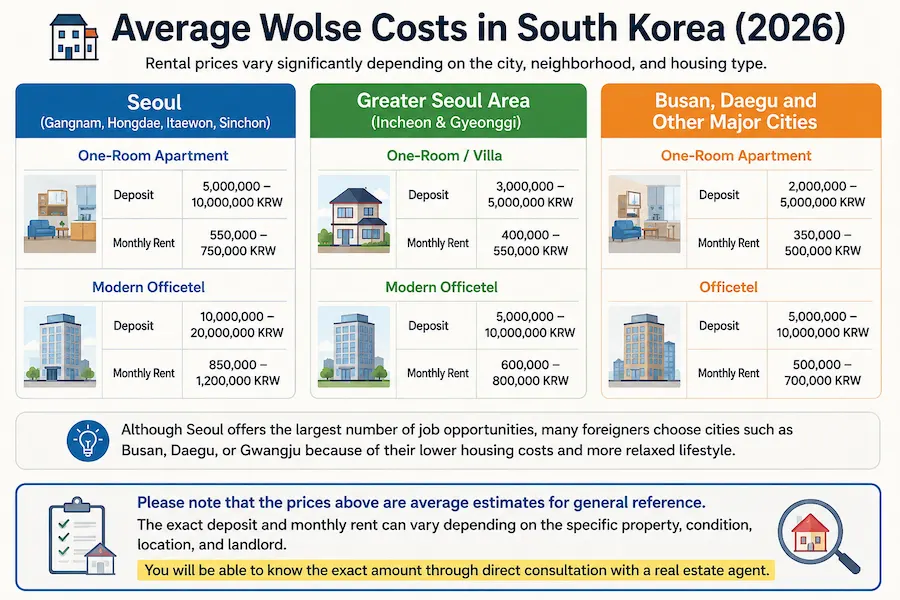
🏙️ Seoul
Seoul has the largest number of job opportunities and foreigner-friendly services in South Korea, but it is also the country’s most expensive housing market.
Popular residential areas include:
- Gangnam
- Hongdae
- Itaewon
- Sinchon
- Jamsil
Many international students, expats, and professionals choose Seoul because of its:
✔️ Extensive public transportation network
✔️ Large international community
✔️ Wide range of career opportunities
🚇 Greater Seoul Area (Incheon & Gyeonggi Province)
The Greater Seoul Area includes Incheon and Gyeonggi Province.
Many foreigners choose these areas because they offer lower housing costs while still providing convenient access to Seoul.
For people who work in Seoul but want more affordable housing, the Greater Seoul Area is often one of the best value-for-money options.
🌊 Busan, Daegu, Gwangju & Other Major Cities
Many foreigners prefer regional cities because of their:
✔️ Lower housing costs
✔️ Less crowded living environments
✔️ More relaxed lifestyles
- Busan is popular for its beaches, international community, and strong work-life balance.
- Daegu is known for its affordability and large student population.
- Gwangju offers a lower cost of living and a vibrant local culture.
Although Seoul remains the most popular destination, regional cities often provide significantly better value for money when it comes to housing.
💡 Tip: Rental prices are important, but they should not be the only factor in your decision.
Before choosing where to live in Korea, also consider:
🌿 Your preferred lifestyle and living environment
🚇 Commuting time and transportation access
🛒 Nearby amenities and daily convenience
💼 Job opportunities
🏢 Can Apartments Also Be Rented Under Wolse?
Yes. Regular Korean apartments can also be rented under the Wolse system.
Apartments are usually larger and more comfortable than one-room apartments or officetels. They are especially popular among families, long-term residents, and people who want a more residential lifestyle.
✅ Common Apartment Features
| Feature | Details |
|---|---|
| 🔒 Security | Many complexes have security offices, CCTV, and controlled access. |
| 🚗 Parking | Underground parking is common in larger apartment complexes. |
| 🛝 Family Facilities | Playgrounds and community spaces are often available. |
| 🏠 Larger Space | Apartments usually offer more rooms and living space. |
⚠️ Important Point for Foreigners
Unlike many officetels or one-room apartments, most Korean apartments are not fully furnished.
In many cases, tenants need to prepare their own:
- Refrigerator
- Washing machine
- Bed
- Sofa
- Dining table
- Curtains
- Other furniture
For short-term foreigners, this can be inconvenient and expensive.
💡 Apartments are usually better for families or foreigners planning to stay in Korea long term. For students, English teachers, and digital nomads, officetels or one-room apartments are often more practical.
⚖️ Understanding Korea’s Deposit-to-Rent Trade-Off
One unique feature of the Korean rental market is that the security deposit and monthly rent can sometimes be adjusted.
In many cases:
⬆️ A higher deposit can lower your monthly rent.
⬇️ A lower deposit usually means a higher monthly rent.
📊 Example
| Option | Security Deposit | Monthly Rent |
|---|---|---|
| Option A | KRW 10,000,000 | KRW 600,000 |
| Option B | KRW 30,000,000 | KRW 500,000 |
In this example, paying an additional KRW 20 million as a deposit reduces the monthly rent by KRW 100,000.
💡 If you have extra savings, increasing the deposit may help lower your monthly housing costs over time.
📌 Can the Deposit Be Negotiated?
Before signing a contract, ask the landlord or real estate agent whether the deposit-to-rent ratio can be adjusted.
A useful Korean phrase is:
이 방 보증금 조절 가능한가요?
Is it possible to adjust the deposit for this room?
Not every landlord will agree, but it is common enough that asking is always worth a try.
🏨 What Is Ggalse (깔세)?
If you do not have enough money for a large deposit, you may come across another rental option called Ggalse (깔세).
Ggalse is a prepaid rent system.
Instead of paying a large security deposit, the tenant pays several months of rent in advance.
📌 Common Ggalse Arrangements
| Type | Example |
|---|---|
| Short-Term | 3 months of rent paid upfront |
| Mid-Term | 6 months of rent paid upfront |
| Long-Term | 12 months of rent paid upfront |
✅ Who Is Ggalse Suitable For?
Ggalse can be a practical option for:
- 🎓 Short-term students
- 💻 Digital nomads
- 🧳 Temporary workers
- ✈️ Foreign visitors staying in Korea for only a few months
In some cases, little or no security deposit is required, and the contract may be extended if both the tenant and landlord agree.
⚠️ Things to Check Before Signing a Ggalse Contract
Because Ggalse is a prepaid rental system, it can be difficult to recover your money if a dispute occurs or if you need to move out earlier than expected.
Before signing a contract, make sure it clearly states:
| Checklist | Confirm |
|---|---|
| 💰 Total prepaid amount | ☐ |
| 📅 Contract period | ☐ |
| 🏠 Move-in and move-out dates | ☐ |
| 💵 Refund conditions | ☐ |
| 🔄 Extension conditions | ☐ |
| 🚪 What happens if you leave early | ☐ |
💡 If anything is unclear, ask the landlord or real estate agent to put it in writing before making any payment.t clearly in the contract before making payment.
⚠️ Hidden Costs Foreigners Often Miss
Many foreigners focus only on monthly rent and forget about the additional costs that come with renting in Korea.
Before signing a Wolse contract, always check whether the following expenses are included or charged separately.
📌 Common Monthly Expenses
| Expense | Usually Included? | Notes |
|---|---|---|
| 🌐 Internet | Sometimes | Often included in one-room apartments, but not always. |
| 🚿 Water | Sometimes | May be included in the maintenance fee. |
| ⚡ Electricity | No | Usually billed separately based on usage. |
| 🔥 City Gas | No | Can become expensive during winter. |
| 🏢 Maintenance Fee | No | Almost always charged separately. |
| 🚗 Parking | Sometimes | Some buildings charge an additional fee. |
💡 These costs can significantly increase your actual monthly housing budget.
🏢 Maintenance Fee (관리비)
Almost every Wolse property charges a monthly maintenance fee called Gwanribi (관리비).
📊 Typical Maintenance Fees
| Housing Type | Typical Range | Common Inclusions |
|---|---|---|
| 🏠 One-Room / Villa | KRW 30,000–70,000 | Cleaning, water, CCTV, shared maintenance |
| 🏢 Officetel | KRW 100,000–200,000+ | Security desk, elevators, parking, lobby maintenance, shared facilities |
⚠️ A property with lower rent may have a much higher maintenance fee. Always ask exactly what is included before signing the contract.
🌐 Internet
Some one-room apartments include internet in the maintenance fee, but this is not guaranteed.
Before signing, ask:
Is internet included in the rent or maintenance fee?
If not, you may need to sign a separate contract with a Korean internet provider.
⚡ Electricity
Electricity is usually billed separately based on your usage.
During summer, running the air conditioner frequently can significantly increase your monthly bill.
🔥 City Gas
City gas is also billed separately and becomes especially important during winter.
Many Korean homes use Ondol (floor heating), which runs on city gas.
⚠️ Leaving the heating on all day can result in surprisingly high gas bills.
💡 Money-Saving Tip: Learn how to use Korea’s Ondol heating system efficiently. Many foreigners accidentally leave the heating on continuously and end up with much higher utility bills than expected.
🏢 Employer-Provided Housing
Before signing a private Wolse contract, check whether your employer offers housing support.
Many English teachers and corporate employees receive benefits such as:
- 🏠 Free housing
- 🏢 Company-provided apartment
- 💰 Monthly housing allowance
- 👥 Shared company accommodation
📌 Common Types of Housing Support
| Benefit | Description |
|---|---|
| 🏠 Free Housing | The employer provides a room or apartment at no cost. |
| 🏢 Company Apartment | The company leases and manages the property for employees. |
| 💰 Housing Allowance | A monthly stipend to help cover rent expenses. |
| 👥 Shared Accommodation | Housing shared with other employees or coworkers. |
⚠️ What Should You Check?
Even if housing is provided, some costs may still be your responsibility.
Ask whether you need to pay for:
- 🏢 Maintenance fees
- 🌐 Internet
- ⚡ Electricity
- 🔥 Gas
- 🚿 Water and other utilities
💡 Employer-provided housing can save you a significant amount of money, but it is still important to understand exactly what is included and what costs you are expected to cover.ails.
📝 How to Secure a Wolse Contract Safely
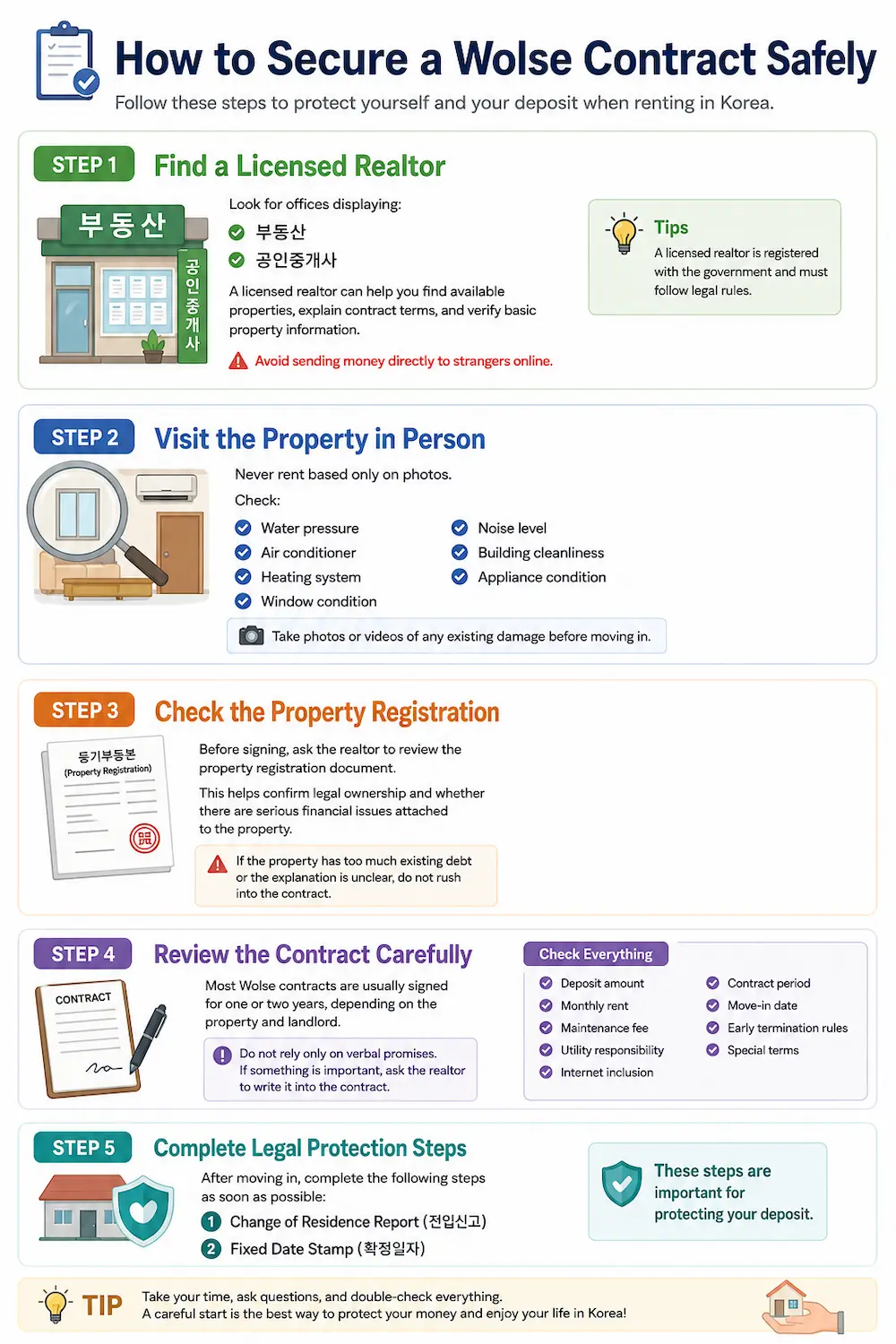
Many rental problems happen because tenants skip important checks, such as reviewing the property registration, confirming maintenance fees, or relying only on verbal promises.
Before paying any deposit, take your time, inspect the property carefully, and make sure all important terms are clearly written in the contract.
💡 A few extra questions before signing can save you from expensive problems later and help protect your deposit.
🛡️ HUG Deposit Insurance
If you are renting a property with a large deposit, HUG Deposit Insurance (전세보증금반환보증) can provide an extra layer of protection.
HUG (Housing & Urban Guarantee Corporation) is a government-backed organization that may reimburse eligible tenants if a landlord becomes insolvent or fails to return the deposit at the end of the lease.
Many Koreans use HUG insurance because it helps reduce the financial risk of losing a large deposit.
📋 Can Foreigners Apply?
Yes. Foreigners are generally eligible to apply for HUG Deposit Insurance.
To qualify, you usually need to:
✔️ Complete your Change of Residence Report (전입신고)
✔️ Obtain a Fixed Date Stamp (확정일자)
✔️ Hold a valid Residence Card (ARC) and legal stay status in Korea
⚠️ Important: The Property Must Also Qualify
Meeting the foreigner requirements does not automatically guarantee approval.
HUG also reviews the property’s financial condition.
Applications may be rejected if:
| Potential Issue | Example |
|---|---|
| 🏦 Excessive mortgage debt | The landlord has too much outstanding debt. |
| 💰 Large senior deposits | Existing tenants have large protected deposits. |
| 📉 High financial risk | The property’s debt is too high compared to its value. |
💡 Even if you have a valid visa, ARC, and completed residency registration, HUG coverage can still be denied if the property is considered financially risky.
📌 Before Signing a High-Deposit Contract
If you are paying a large deposit, ask your realtor:
“Is this property likely to qualify for HUG Deposit Insurance?”
Taking a few minutes to confirm HUG eligibility can help protect your deposit and avoid costly surprises later.
🛠️ Essential Tips for Foreigners
Add an Appliance Repair Clause
If the room includes built-in appliances, ask who is responsible for repairs.
Important appliances include:
- Refrigerator
- Washing machine
- Air conditioner
- Boiler
If possible, ask the realtor to include a clause stating that the landlord is responsible for repairing built-in appliances damaged through normal wear and tear.
Keep Track of Your Contract Expiration Date
If you plan to move out when the lease ends, notify the landlord in advance.
Do not wait until the last minute.
Contract renewal and move-out rules can vary, so discuss your plan early.
Never Move Out Before Receiving Your Deposit
When your lease ends, confirm that your deposit has been returned before handing over the keys completely.
Once you leave the property, it may become harder to resolve deposit-related disputes.
🏨 Consider Short-Term Housing First
If this is your first time moving to South Korea, consider staying in short-term accommodation before signing a long-term lease.
📌 Popular Short-Term Options
| Type | Best For |
|---|---|
| 🏨 Hotel | A few days to a few weeks |
| 🏢 Residence Hotel | Longer stays with basic amenities |
| 🏠 Airbnb | Temporary housing while apartment hunting |
| 🎒 Guesthouse | Budget-friendly short-term stays |
✅ Why Start with Short-Term Housing?
Staying in temporary accommodation gives you time to:
✔️ Explore different neighborhoods
✔️ Compare rental prices
✔️ Check transportation and commuting times
✔️ Visit properties in person
✔️ Avoid making rushed decisions from overseas
💡 Many foreigners regret signing a long-term lease before seeing the neighborhood and the property in person.
A few weeks in short-term housing can help you find a better apartment, avoid costly mistakes, and settle into life in Korea more comfortably.
📱 Useful Apps for Finding Housing in Korea
Two of the most popular real estate apps in Korea are Zigbang (직방) and Dabang (다방).
These apps let you:
✔️ Compare rental prices
✔️ Explore different neighborhoods
✔️ Filter by budget and property type
✔️ Save listings before visiting in person
💡 Although the apps are helpful, always inspect the property yourself before signing a contract or sending any money.
❌ Common Mistakes to Avoid
Before signing a Wolse contract, make sure you avoid these common mistakes.
| Mistake | Why It Matters |
|---|---|
| 📄 Signing without understanding the contract | You may miss important payment, refund, or termination terms. |
| 🧾 Ignoring maintenance fees | Your actual monthly cost may be higher than expected. |
| 🌐 Assuming internet is included | Some properties require a separate internet contract. |
| ⚡ Forgetting utility bills | Electricity and gas are often charged separately. |
| 💸 Sending a deposit too early | Never send money before viewing the property and confirming details. |
| 📸 Trusting online photos only | Photos may be outdated or misleading. |
| 🛡️ Skipping the Fixed Date Stamp | This can weaken your deposit protection. |
| 🏠 Forgetting address registration | Long-term residents must report their new address. |
| 🏨 Ignoring Ggalse refund terms | Prepaid rent may be difficult to recover if terms are unclear. |
💡 A little preparation can help you avoid expensive problems and rent more safely in Korea.
❓ Frequently Asked Questions (FAQ)
Q. How much money should I prepare before renting a Wolse apartment?
It depends on the location and property type, but most foreigners should prepare enough money for the security deposit, first month’s rent, real estate commission, and moving expenses.
Q. Can I negotiate the monthly rent or deposit?
Sometimes.
Some landlords are willing to adjust the deposit-to-rent ratio or offer discounts, especially if you plan to stay for a longer period.
Q. Can two or more people share a Wolse apartment?
Usually, yes.
However, some landlords limit the number of occupants, so always confirm this before signing the contract.
Q. What happens if I want to move out before the contract ends?
Most Wolse contracts include early termination conditions and possible penalties.
Always check the contract carefully and ask who is responsible for finding a replacement tenant if you leave early.
Q. Do I need renter’s insurance in Korea?
It is not legally required, but renter’s insurance can provide additional protection for your belongings and liability coverage. Some foreigners also choose deposit insurance for extra peace of mind.
🎯 Final Thoughts
Wolse (월세) is the most common and practical rental system for foreigners living in South Korea.
Although Korea’s deposit system may feel unfamiliar at first, renting becomes much easier once you understand deposits, monthly rent, maintenance fees, utilities, and contract terms.
Different housing options suit different needs:
- 🏠 One-room apartments and officetels are often ideal for students, professionals, and short-term residents.
- 🏨 Ggalse arrangements can be a practical option for people who need flexible, short-term housing.
- 🏢 Apartments are usually better suited for families and long-term residents, although they are often unfurnished.
Before signing any contract, always confirm:
✔️ What is included in the rent and maintenance fee
✔️ Whether internet and utilities are charged separately
✔️ Deposit refund conditions and special contract terms
✔️ Your legal protections, including address registration and a Fixed Date Stamp
💡 With the right preparation, a licensed realtor, and a clear written contract, renting under the Wolse system in Korea can be safe, flexible, and much less stressful.
📚 Related Korea Living Guides:
How to Rent a Motel in Korea for a Month (Dalbang Guide for Foreigners)
One-Room vs Officetel vs Gosiwon in Korea
How to Rent a House in South Korea
How to Protect Your Housing Deposit in Korea
How to Get a Korea ARC (Residence Card): Complete Guide