Renting a house in South Korea can feel overwhelming for foreigners moving to Korea for the first time.
Before starting your housing search, it’s important to understand the four most common types of housing available in Korea. Each option differs in terms of cost, location, convenience, and lifestyle, so choosing the right one can make your transition much easier.
🏠 Renting a House in South Korea: What Foreigners Need to Know
📊 Quick Comparison
| Housing Type | Advantages | Disadvantages | Best For |
|---|---|---|---|
| 🏢 Apartment (아파트) | Excellent security, underground parking, community facilities | Higher rent and maintenance fees | Families and professionals |
| 🏙️ Officetel (오피스텔) | Convenient locations, strong security, often fully furnished | Higher maintenance fees, smaller living space | Expats and students |
| 🏘️ Villa (빌라) | Lower rent, larger living space | Limited parking, older buildings | Budget-Conscious Residents |
| 🏠 One-Room (원룸) | Affordable, easy to find, often furnished | Small space, poor soundproofing | Students & Newcomers |
🏢 Apartment (아파트)
Apartments are generally considered the most desirable housing option in South Korea, especially for families and long-term residents.
📊 Apartment at a Glance
| Category | Details |
|---|---|
| 🔒 Security | 24-hour security and controlled access |
| 🚗 Parking | Underground parking available in most complexes |
| 🌳 Community Facilities | Parks, playgrounds, gyms, and community centers |
| 👨👩👧 Lifestyle | Family-friendly neighborhoods and excellent amenities |
| 💰 Cost | Higher rent, deposits, and maintenance fees |
| 🛋️ Furnishing | Often rented unfurnished |
Because of these benefits, apartments are especially popular among people looking for comfort, convenience, and a long-term place to live.
However, they are also the most expensive housing option in Korea. Monthly rent, security deposits, and maintenance fees tend to be significantly higher than those of officetels, villas, or one-room apartments.
In addition, many apartments come without furniture or appliances, so new tenants may need to purchase their own essentials.
💡 Best for: Families, professionals, and long-term residents who prioritize space, security, and community facilities.
🏙️ Officetel (오피스텔)
An officetel is a hybrid between an office and an apartment and is one of the most popular housing options for foreigners living in Korea.
📊 Officetel at a Glance
| Category | Details |
|---|---|
| 📍 Location | Usually near subway stations, business districts, and shopping areas |
| 🛋️ Furnishing | Often offered as full-option units with furniture and appliances |
| 🚇 Convenience | Excellent access to public transportation and daily amenities |
| 🔒 Security | Modern buildings with secure entrances and CCTV |
| 💰 Cost | Higher rent and maintenance fees than one-room apartments |
| 📏 Living Space | Generally smaller than apartments or villas |
Many officetels come with:
✅ Refrigerator
✅ Washing machine
✅ Air conditioner
✅ Wardrobe and basic furniture
Because of their convenience and move-in-ready condition, officetels are especially popular among expats, students, and digital nomads.
💡 Best for: Expats, students, and anyone moving to Korea for the first time.
👉 Related Guide: One-Room vs Officetel vs Gosiwon in Korea
🏘️ Villa (빌라)
In Korea, a villa does not refer to a luxury mansion. Instead, it describes a low-rise residential building, usually three to five stories tall, located in local neighborhoods.
📊 Villa at a Glance
| Category | Details |
|---|---|
| 💰 Cost | Lower rent and deposits than apartments |
| 📏 Living Space | Generally larger than officetels and one-rooms |
| 🌳 Neighborhood | Often located in quiet residential areas |
| 🚗 Parking | Limited parking in many buildings |
| 🔒 Security | Fewer security features than apartments |
| 🏢 Building Age | Many villas are older buildings |
Compared to apartments and officetels, villas often provide more space for less money, making them one of the best-value housing options in Korea.
However, some villas may lack modern facilities and the convenience offered by larger apartment complexes.
💡 Best for: Residents looking for more space without paying apartment prices.
🏠 One-Room (원룸)
A one-room is a compact studio-style apartment that combines the bedroom, kitchen, and living area into a single space.
It is one of the most affordable and easiest housing options to find in South Korea.
📊 One-Room at a Glance
| Category | Details |
|---|---|
| 💰 Cost | Usually the cheapest rental option |
| 📍 Location | Common near universities, business districts, and subway stations |
| 🛋️ Furnishing | Often partially or fully furnished |
| 📏 Living Space | Small and compact |
| 🔊 Soundproofing | Often poor, especially in older buildings |
| 🏃 Convenience | Easy to find and quick to move into |
Advantages include:
✅ Low upfront costs
✅ Convenient locations
✅ Furnished options available
The biggest drawbacks are limited space and poor soundproofing, which can be challenging for long-term residents.
Even so, one-rooms remain one of the most practical choices for students and newcomers.
💡 Best for: Students, working holiday travelers, and newcomers on a budget.
📊 Which Housing Type Should You Choose?
Still not sure which option is right for you? Here’s a quick guide based on different situations.
| If You… | Recommended Housing Type |
|---|---|
| Are moving to Korea for the first time | 🏙️ Officetel |
| Are on a tight budget | 🏠 One-Room |
| Have children or need more space | 🏢 Apartment |
| Want the best value for money | 🏘️ Villa |
| Work remotely or need a convenient location | 🏙️ Officetel |
| Plan to stay in Korea long-term | 🏢 Apartment or 🏘️ Villa |
💡 Quick Tip: For most foreigners moving to Korea for the first time, an officetel under the Wolse (monthly rent) system is often the easiest and safest choice. It typically offers a convenient location, modern facilities, and fewer complications than a Jeonse contract.
💰 Korean Rental Systems Explained
One of the most unique aspects of renting in South Korea is its rental payment system.
Unlike many countries where tenants simply pay monthly rent, Korea offers several different ways to structure a lease. Understanding these systems is essential before signing a rental contract, as the required deposit and monthly costs can vary significantly.
📊 Quick Comparison
| Rental System | Deposit | Monthly Rent | Best For |
|---|---|---|---|
| 🏦 Jeonse (전세) | Very high | ❌ None | Long-term residents with significant savings |
| 💵 Wolse (월세) | Moderate | ✅ Monthly payment | Most foreigners and first-time residents |
| ⚖️ Ban-Jeonse (반전세) | High | ✅ Reduced monthly rent | Long-term residents seeking lower monthly costs |
| 🧳 Ggalse (깔세) | Low or none | Paid upfront | Short-term visitors and temporary stays |
💡 Quick Overview
- Jeonse (전세): Pay a large deposit instead of monthly rent.
- Wolse (월세): Pay a smaller deposit plus monthly rent.
- Ban-Jeonse (반전세): A hybrid system with a higher deposit and lower monthly rent.
- Ggalse (깔세): Pay the entire rental amount upfront, usually for short-term stays.
💡 Quick Tip: For most foreigners moving to Korea for the first time, Wolse (월세) is usually the easiest and most practical option because it requires a lower upfront cost and is widely available.
🏦 Jeonse (전세)
Jeonse is Korea’s famous deposit-based rental system and one of the country’s most unique housing concepts.
Instead of paying monthly rent, tenants provide a large security deposit, and in return, they live in the property without paying monthly rent.
📊 Jeonse at a Glance
| Category | Details |
|---|---|
| 💰 Deposit | Typically 60%–80% of the property’s value |
| 🏠 Monthly Rent | ❌ None |
| 📅 Contract Length | Usually 2 years |
| 🔄 Deposit Return | Returned at the end of the lease (if there are no issues) |
| 👥 Best For | Long-term residents with significant savings |
💡 Example
If a property is worth 300 million KRW (₩300,000,000), the Jeonse deposit could range from approximately:
💰 180 million KRW (₩180,000,000)
to
💰 240 million KRW (₩240,000,000).
This means you can live in the property for two years without paying monthly rent, provided you can afford the large upfront deposit.
✅ Advantages
✅ No monthly rent payments
✅ Lower long-term housing costs
✅ Potentially cheaper than Wolse over several years
⚠️ Disadvantages
❌ Requires a very large upfront deposit
❌ Not practical for most foreigners or first-time residents
❌ Risk of delayed or incomplete deposit returns
🚨 Important Risk
Although Jeonse can significantly reduce monthly housing expenses, it also carries one major risk:
The landlord may not be able to return your deposit when the contract ends.
For this reason, it’s important to:
✅ Verify the property’s ownership
✅ Check for existing loans or mortgages
✅ Understand how to legally protect your deposit
💡 Quick Tip: For most foreigners moving to Korea for the first time, Wolse (월세) is usually a safer and more practical option than Jeonse because it requires a much smaller upfront investment.
💵 Wolse (월세)
Wolse is the most common rental system used by foreigners living in South Korea.
Under this system, tenants pay a security deposit along with a monthly rent payment, making it much more accessible than Jeonse.
📊 Wolse at a Glance
| Category | Details |
|---|---|
| 💰 Deposit | Usually low to moderate |
| 🏠 Monthly Rent | ✅ Required |
| 📅 Contract Length | Usually 1–2 years |
| 🔄 Deposit Return | Returned at the end of the lease (if there are no issues) |
| 👥 Best For | Most foreigners, students, and newcomers |
💡 Example
A typical Wolse contract might look like this:
💰 Deposit: 10 million KRW (₩10,000,000)
🏠 Monthly Rent: 700,000 KRW (₩700,000) per month
✅ Advantages
✅ Lower upfront costs than Jeonse
✅ Easier for newcomers and first-time residents
✅ Greater flexibility
✅ Widely available throughout Korea
⚠️ Disadvantages
❌ Ongoing monthly rent payments
❌ Higher long-term costs than Jeonse
❌ Monthly expenses can add up over time
💡 Who Usually Chooses Wolse?
Most students, expats, English teachers, and digital nomads choose Wolse because it requires significantly less initial capital than Jeonse.
For many foreigners, it is the easiest and most practical way to rent a home in Korea.
⚖️ Ban-Jeonse (반전세)
Ban-Jeonse is a hybrid rental system that combines elements of Jeonse and Wolse.
Tenants provide a larger deposit than a standard Wolse contract, but in exchange, the monthly rent is significantly reduced.
📊 Ban-Jeonse at a Glance
| Category | Details |
|---|---|
| 💰 Deposit | Higher than Wolse, lower than Jeonse |
| 🏠 Monthly Rent | ✅ Lower than Wolse |
| 📅 Contract Length | Usually 2 years |
| 🔄 Deposit Return | Returned at the end of the lease (if there are no issues) |
| 👥 Best For | Long-term residents with some savings |
💡 Example
A typical Ban-Jeonse contract might look like this:
💰 Deposit: 100 million KRW (₩100,000,000)
🏠 Monthly Rent: 300,000 KRW (₩300,000) per month
✅ Advantages
✅ Lower monthly rent than Wolse
✅ Smaller deposit than a full Jeonse contract
✅ Good balance between upfront costs and monthly expenses
⚠️ Disadvantages
❌ Requires a much larger deposit than Wolse
❌ Not ideal for newcomers with limited savings
❌ Fewer listings compared to standard Wolse properties
💡 Who Usually Chooses Ban-Jeonse?
Ban-Jeonse is often preferred by long-term residents who want lower monthly housing costs but don’t have enough funds for a full Jeonse deposit.
🧳 Ggalse (깔세)
Ggalse is a short-term rental arrangement commonly used by temporary residents in Korea.
Instead of paying a large security deposit, tenants pay several months of rent upfront.
📊 Ggalse at a Glance
| Category | Details |
|---|---|
| 💰 Deposit | Low or none |
| 🏠 Monthly Rent | Paid upfront for several months |
| 📅 Contract Length | Usually a few weeks to several months |
| 🔄 Deposit Return | Usually not applicable |
| 👥 Best For | Short-term visitors and temporary residents |
✅ Advantages
✅ Little or no security deposit required
✅ Flexible contract periods
✅ Suitable for short-term stays
⚠️ Disadvantages
❌ Limited availability
❌ Higher effective monthly costs in some cases
❌ Fewer legal protections than standard leases
💡 Who Usually Chooses Ggalse?
Ggalse can be a practical option for:
✅ International students
✅ Digital nomads
✅ Temporary workers
✅ Short-term visitors
It is especially useful for people staying in Korea for only a few months and who want to avoid paying a large security deposit.
📊 Which Rental System Should You Choose?
| If You… | Recommended Rental System |
|---|---|
| Are moving to Korea for the first time | 💵 Wolse |
| Need the lowest upfront cost | 🧳 Ggalse |
| Have some savings and want lower monthly rent | ⚖️ Ban-Jeonse |
| Have significant savings and plan to stay long-term | 🏦 Jeonse |
💡 Quick Tip: For most foreigners moving to Korea for the first time, Wolse (월세) is generally the safest and easiest option. It requires a manageable deposit, offers flexibility, and avoids many of the risks associated with large Jeonse deposits. As you become more familiar with the Korean housing market, you can explore other rental systems that better match your budget and long-term plans.
🏙️Average Rent by Area in South Korea
Housing costs in South Korea vary significantly depending on the city and neighborhood.
While Seoul offers the most job opportunities and international communities, it is also by far the most expensive housing market in the country. Regional cities, on the other hand, often provide a more affordable cost of living and better value for money.
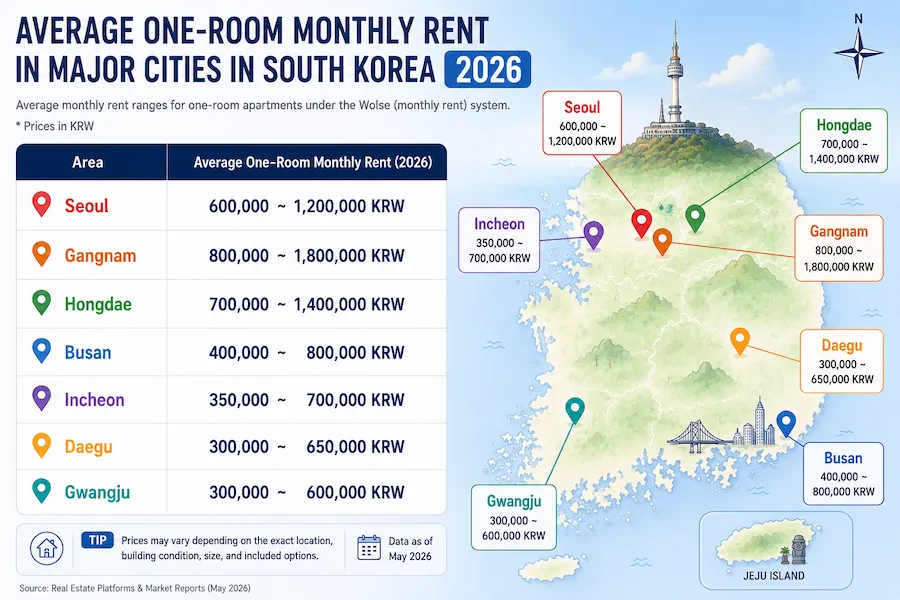
🌆 Seoul
Seoul offers the largest selection of housing, jobs, and international communities in South Korea.
Popular residential areas include:
📍 Gangnam
📍 Hongdae
📍 Jamsil
📍 Itaewon
📍 Yeouido
Although housing costs are high, many foreigners choose Seoul because of its:
✅ Career opportunities
✅ Extensive public transportation network
✅ Large expat community
✅ Convenient urban lifestyle
📍 Popular Areas in Seoul
| Area | Best For | Cost Level |
|---|---|---|
| 🏢 Gangnam | Professionals and business workers | 💰💰💰💰💰 |
| 🎵 Hongdae | Students and digital nomads | 💰💰💰💰 |
| 🏙️ Jamsil | Families and long-term residents | 💰💰💰💰 |
| 🌍 Itaewon | Expats and international communities | 💰💰💰💰 |
| 🏢 Yeouido | Finance professionals | 💰💰💰💰 |
🏢 Gangnam
Gangnam is one of the most expensive districts in South Korea.
The area is known for:
✅ Modern officetels and luxury apartments
✅ Premium office buildings
✅ Excellent transportation
✅ Major business and technology companies
It is especially popular among professionals working in finance, technology, and multinational corporations.
🎵 Hongdae
Hongdae is one of the most popular neighborhoods among:
✅ International students
✅ Digital nomads
✅ Younger expats
The area is famous for its:
🎶 Live music and nightlife
☕ Cafés and restaurants
🎨 Creative atmosphere
🎓 University culture
Because of its popularity, housing demand remains consistently high throughout the year.
🌊 Busan
Busan is South Korea’s second-largest city and offers a more relaxed lifestyle than Seoul.
Why Foreigners Choose Busan
✅ Lower housing costs
✅ Beautiful beaches
✅ Growing international community
✅ Better work-life balance
Popular areas include:
📍 Haeundae
📍 Seomyeon
📍 Gwangalli
✈️ Incheon
Located directly west of Seoul, Incheon has become increasingly attractive to foreigners seeking lower housing costs while maintaining easy access to the capital.
Advantages of Living in Incheon
✅ More affordable rent than Seoul
✅ Excellent transportation links
✅ Close to Incheon International Airport
✅ Modern residential developments
Many commuters choose to live in Incheon while working in Seoul.
🌳 Daegu
Daegu remains one of the most affordable major cities in South Korea.
It is particularly popular among:
✅ English teachers
✅ Students
✅ Long-term residents
Despite its lower housing costs, Daegu still offers:
🚇 Modern public transportation
🏙️ Urban conveniences
🌳 Comfortable living environment
🍃 Gwangju
Gwangju is one of South Korea’s most affordable metropolitan cities and is known for its strong cultural identity and relaxed pace of life.
Why People Choose Gwangju
✅ Lower housing costs
✅ Excellent value for money
✅ Rich food and cultural scene
✅ Access to beautiful natural attractions
The city is especially attractive to:
🎓 Students
👨🏫 Teachers
🏡 Long-term residents
📊 Which City Should You Choose?
| If You Want… | Recommended City |
|---|---|
| The most job opportunities | 🌆 Seoul |
| Beaches and a relaxed lifestyle | 🌊 Busan |
| Lower costs with easy access to Seoul | ✈️ Incheon |
| Affordable city living | 🌳 Daegu |
| The best value for money | 🍃 Gwangju |
💡 Quick Tip: Rent is important, but it shouldn’t be your only consideration. Before choosing where to live in Korea, also think about commuting time, public transportation, nearby amenities, job opportunities, and the lifestyle you want.
🔍 How Foreigners Find Housing in Korea
Finding a place to live in South Korea has become much easier thanks to online property platforms and foreigner-friendly housing services.
Whether you’re looking for an officetel, one-room apartment, villa, or family apartment, knowing where to search can save you time, money, and unnecessary frustration.
📊 Housing Search Options in Korea
| Option | Best For | English | Key Advantage |
|---|---|---|---|
| 📱 Zigbang & Dabang | Market research | ❌ Limited | Huge number of listings |
| 🏠 Naver Real Estate | Price comparisons | ❌ Limited | Reliable market information |
| 🏢 Local Realtors | Renting a home | ⚠️ Varies | Viewings and contract assistance |
| 🌏 Foreigner-Friendly Services | First-time renters | ✅ Good | English support and guidance |
💡 Quick Tip: Use property apps to research prices and neighborhoods, but rely on a licensed realtor when you’re ready to rent.
📱 Zigbang (직방) & Dabang (다방)
Zigbang and Dabang are Korea’s two largest property apps and offer listings for:
✅ Apartments
✅ Officetels
✅ Villas
✅ One-room apartments
They are useful for checking:
📷 Property photos
📍 Locations and maps
💰 Rental prices and deposits
🏘️ Neighborhood information
⚠️ Good to Know: Most listings are written entirely in Korean, and popular properties can disappear quickly.
💡 Best for: Researching neighborhoods and getting a general idea of local rental prices.
🏠 Naver Real Estate (네이버 부동산)
Naver Real Estate is one of Korea’s most trusted property websites and is widely used by licensed realtors.
Why It’s Useful
✅ Compare rental prices
✅ Check local market trends
✅ View property photos
✅ Research different neighborhoods
⚠️ Good to Know: The website is designed primarily for Korean speakers, so many foreigners use Google Chrome’s translation feature.
💡 Best for: Comparing prices and understanding the local housing market before contacting a realtor.
🏢 Local Realtors (부동산)
Despite the popularity of online platforms, local realtors remain the most effective way to rent a home in Korea.
A licensed realtor can help you:
✅ Find available properties
✅ Arrange property viewings
✅ Explain contract terms
✅ Verify listings and maintenance fees
✅ Negotiate rental conditions
⚠️ Good to Know: Many neighborhood realtors speak little or no English. If possible, bring a Korean-speaking friend or use an interpreter.
💡 Best for: Completing the rental process safely and avoiding misunderstandings.
🌏 Foreigner-Friendly Housing Services
Some agencies specialize in helping foreigners find housing in Korea and provide support throughout the rental process.
📊 Popular Options
| Service | Best For | English Support |
|---|---|---|
| 🏠 Ziptoss (직토스) | First-time renters | ✅ Excellent |
| 🌍 Expat Housing Agencies | Foreign professionals | ✅ Excellent |
| 🎓 University Housing Offices | International students | ✅ Good |
| 👥 Verified Facebook Groups | Budget-conscious renters | ⚠️ Varies |
📊 What These Services Usually Provide
| Service | Included |
|---|---|
| 🗣️ English Support | Communication and translation assistance |
| 🏡 Housing Recommendations | Properties tailored to your needs |
| 📝 Contract Guidance | Help understanding lease terms |
| 🤝 Rental Assistance | Support throughout the entire process |
💡 Good to Know: These services may charge slightly higher fees, but many foreigners find the convenience worthwhile—especially during their first housing search in Korea.
Best for: International students, digital nomads, and foreign employees relocating to Korea. 🌏🏠
📊 Recommended Housing Search Process
| Step | What to Do |
|---|---|
| 1️⃣ | Research neighborhoods and compare prices |
| 2️⃣ | Set a realistic housing budget |
| 3️⃣ | Contact a licensed local realtor |
| 4️⃣ | Visit properties in person |
| 5️⃣ | Review the contract carefully before signing |
💡 Quick Tip: Most foreigners start by searching for an officetel or one-room apartment online and then visit a local realtor to arrange viewings and finalize the contract. This approach offers the best balance of convenience, safety, and reliability when renting a home in South Korea. 🇰🇷🏠
📝 Before Signing a Rental Contract
Before paying a deposit or signing a lease, take a few minutes to review the details below. A simple check now can help you avoid expensive problems later.
📊 Rental Contract Checklist
| Item | What to Check |
|---|---|
| 💰 Deposit (보증금) | Confirm the exact amount and verify the property owner. |
| 🏠 Monthly Rent (월세) | Check the rent amount, due date, and payment method. |
| 🧾 Maintenance Fee (관리비) | Ask what is included and whether utilities are charged separately. |
| 📅 Contract Period | Confirm the move-in date, renewal terms, and early termination penalties. |
| 🛋️ Furniture & Appliances | Verify what is included and whether everything works properly. |
| 🐶 Pets & Parking | Check pet restrictions and parking availability or fees. |
💰 Deposit & Monthly Rent
Before signing a rental contract, make sure you fully understand both the security deposit (보증금) and the monthly rent (월세).
📊 What to Check Before Signing
| Item | Questions to Ask |
|---|---|
| 💰 Deposit (보증금) | What is the exact deposit amount? Who legally owns the property? Can the deposit be legally protected? |
| 🏠 Monthly Rent (월세) | How much is the monthly rent? When is payment due? What payment method should be used? |
⚠️ Important: Never rely on verbal agreements. Make sure all important terms—including the deposit amount, rent, and payment conditions—are clearly written in the contract.
🧾 Maintenance Fee (관리비)
Maintenance fees can vary significantly, especially in officetels.
📊 Ask What’s Included
| Included Item | Commonly Covered? |
|---|---|
| 💧 Water | Sometimes |
| 🌐 Internet / Wi-Fi | Sometimes |
| 🧹 Cleaning Services | Often |
| 🔒 Building Security | Often |
| 🛗 Elevator Maintenance | Often |
| 🚗 Parking | Varies |
⚠️ Budget Trap: A property with lower rent may have surprisingly high maintenance fees.
Also remember that electricity and city gas (Ondol heating) are usually billed separately based on actual usage.
📅 Contract Period
Most rental contracts in Korea are signed for two years.
Before signing, confirm:
✅ Contract start date
✅ Official move-in date
✅ Renewal conditions
✅ Early termination penalties
🛋️ Furniture & Appliances (Full Option Check)
Don’t assume a property is fully furnished just because it’s advertised as Full Option.
📊 Check What’s Included
| Item | Included? |
|---|---|
| 🧊 Refrigerator | ⬜ |
| 👕 Washing Machine | ⬜ |
| ❄️ Air Conditioner | ⬜ |
| 🛏️ Bed or Mattress | ⬜ |
| 🗄️ Wardrobe & Storage | ⬜ |
💡 Pro Tip: Take photos or videos during the viewing and ask who is responsible for repairs if an appliance stops working.
If possible, request that these details be added to the Special Terms (특약) section of the contract.
🐶 Pet Policy & Parking
| Item | Questions to Ask |
|---|---|
| 🐶 Pet Policy | Are pets allowed? Are there restrictions on certain animals or breeds? |
| 🚗 Parking | Is parking available? Is a parking space guaranteed? Are there additional monthly fees? |
💡 Good to Know: Some buildings prohibit pets entirely, while others may charge additional fees for parking or limit the number of registered vehicles.
📋 Final Pre-Signing Checklist
Before transferring any money, make sure you have:
☑️ Verified the deposit and rent amounts
☑️ Checked maintenance fees and utilities
☑️ Confirmed the contract period
☑️ Inspected furniture and appliances
☑️ Asked about pets and parking
☑️ Visited the property in person
💡 Quick Tip: Never sign a lease based solely on online photos or videos. Whenever possible, visit the property in person and inspect the condition of the unit before making any payment. 🏠🇰🇷
⚠️ Common Rental Risks Foreigners Should Know
South Korea is generally a safe and reliable place to rent a home, but there are still a few risks that foreign tenants should be aware of.
📊 Common Rental Risks
| Risk | Why It Matters | How to Avoid It |
|---|---|---|
| 📄 Contract Language | Important terms may be misunderstood due to language barriers. | Ask a Korean-speaking friend, interpreter, or English-speaking realtor for help. |
| 💸 Unexpected Costs | Utility bills and maintenance fees can be higher than expected. | Confirm all monthly costs before signing the lease. |
| 🔥 High Winter Heating Bills | Older buildings can have expensive city gas (Ondol) charges during winter. | Ask about average utility costs before moving in. |
| 🏠 Deposit Fraud | Sending money before verifying the property can be risky. | Never transfer a large deposit before confirming ownership and the realtor’s credentials. |
🚨 Biggest Mistake to Avoid
Never send a large deposit from overseas without first verifying:
✅ The property’s registered ownership
✅ The landlord’s identity
✅ The licensed realtor handling the transaction
💡 Quick Tip: If you don’t fully understand something in the contract, don’t feel pressured to sign. Taking a little extra time to verify the details can save you from expensive problems later. 🏠🇰🇷
🛡️ How to Protect Your Deposit: HUG Insurance
If you’re signing a Jeonse contract or a high-deposit Wolse agreement, it’s worth learning about HUG Deposit Insurance (전세보증금반환보증).
HUG (Housing & Urban Guarantee Corporation) is a government-backed organization that helps protect tenants if a landlord is unable to return their deposit at the end of the lease.
For many Korean tenants, HUG insurance is an important safeguard when dealing with large housing deposits.
📊 Basic Requirements
| Requirement | Details |
|---|---|
| 🏠 Residence Registration | Complete your Change of Residence Report (전입신고) |
| 📅 Fixed Date Stamp | Obtain a Fixed Date Stamp (확정일자) |
| 🪪 Residence Status | Hold a valid Residence Card (ARC) if required |
| 📄 Property Requirements | Meet HUG’s eligibility rules and contract requirements |
🌏 Can Foreigners Apply?
In many cases, yes.
Foreign residents may also be eligible for HUG Deposit Insurance if they meet the necessary residency and property requirements.
💡 Quick Tip: If you’re paying a large deposit, especially under a Jeonse contract, consider checking whether HUG Deposit Insurance is available before signing the lease. It can provide valuable protection if your landlord is unable to return your deposit.
Related Korea Living Guides: How to Protect Your Housing Deposit in Korea
❓ Frequently Asked Questions
Q.Can foreigners rent a home in Korea?
Yes. Foreigners can rent apartments, officetels, villas, and one-room apartments in Korea with the required documents.
Q.Which rental system is best for foreigners?
For most newcomers, Wolse (월세) is usually the easiest and safest option because it requires a lower upfront deposit than Jeonse.
Q.Do I need an ARC to rent a home?
Not always. However, having an ARC makes the rental process much easier, especially for long-term contracts.
Q.Can foreigners apply for HUG Deposit Insurance?
In many cases, yes. Foreign residents may be eligible if they meet the residency and property requirements.
Q.Should I visit the property before signing?
Absolutely. Never rely solely on online photos. Inspect the property in person whenever possible before transferring any money.
🎯 Final Thoughts
Renting a home in South Korea can feel overwhelming at first, especially if you’re unfamiliar with Jeonse, Wolse, and Korea’s unique deposit system.
The good news is that once you understand the basics, the process becomes much easier.
By learning about housing types, rental costs, contract terms, and ways to protect your deposit, you can avoid common mistakes and make more confident decisions.
Whether you’re moving into a modern officetel in Seoul, a spacious villa in Busan, or a budget-friendly one-room near a university, taking the time to research the market will make your transition to life in Korea much smoother.
💡 The key to renting successfully in Korea is simple: understand the system, verify important details before signing, and never rush into paying a deposit or signing a contract.
With the right preparation, finding a home in South Korea can be a straightforward and rewarding experience, allowing you to focus on settling in and enjoying your new life in Korea. 🇰🇷🏠
📚 Related Korea Living Guides:
How to Rent a Motel in Korea for a Month (Dalbang Guide for Foreigners)
Wolse in Korea: Complete Monthly Rent Guide for Foreigners
One-Room vs Officetel vs Gosiwon in Korea
How to Get a Korea ARC (Residence Card): Complete Guide