Resident vs Non-Resident in Korea is one of the most important financial concepts to understand before opening a bank account or managing your money in South Korea.
Many foreigners assume that their nationality determines how Korean banks treat them. In reality, banks are usually far more concerned with your legal residency status.
This classification can affect almost every aspect of your banking experience, including:
✔ Opening a bank account
✔ Accessing mobile banking services
✔ Sending money overseas
✔ Receiving a debit card
✔ Understanding transaction limits and account restrictions
If you’ve ever wondered why one foreigner can open a bank account in just a few minutes while another is asked to provide additional documents, the answer often comes down to whether they are considered a resident or a non-resident.
Understanding Resident vs Non-Resident in Korea is essential because the rules, requirements, and banking services available to you can vary significantly depending on your status.
💡 Quick Korean Financial Terms
Before diving into the details, it helps to understand the terms commonly used by Korean banks.
🟢 Resident (거주자 · Geo-ju-ja)
A Resident is a foreigner who has established a long-term presence in Korea.
This typically includes people who are:
✔ Working in Korea
✔ Studying in Korea
✔ Married to a Korean citizen
✔ Living in Korea on a long-term visa
In most cases, residents hold an Alien Registration Card (ARC) or Residence Card and stay in Korea for more than 183 days.
🔵 Non-Resident (비거주자 · Bi-geo-ju-ja)
A Non-Resident is a foreigner who does not have long-term residency status in Korea.
This generally includes:
✔ Tourists
✔ Short-term visitors
✔ People staying in Korea without a long-term visa
Because non-residents have a different legal and financial status, banks often apply additional restrictions to their accounts and banking services.
👤 Resident vs. ✈️Non-Resident in Korea: Why It Matters
Before opening a bank account in Korea, it’s important to understand whether you are classified as a resident or a non-resident.
This distinction plays a major role in determining which banking services you can access and how easily you can use them.
In general:
- Residents are foreigners who have established a long-term presence in Korea, such as workers, international students, marriage visa holders, and permanent residents. Most residents hold an Alien Registration Card (ARC) or another form of official Korean residency documentation.
- Non-residents typically include tourists, K-ETA visitors, short-term business travelers, and individuals without an ARC.
Although two foreigners may visit the same bank branch on the same day, their banking experience can be completely different depending on their residency status.
The infographic below highlights the key differences between residents and non-residents in Korea.
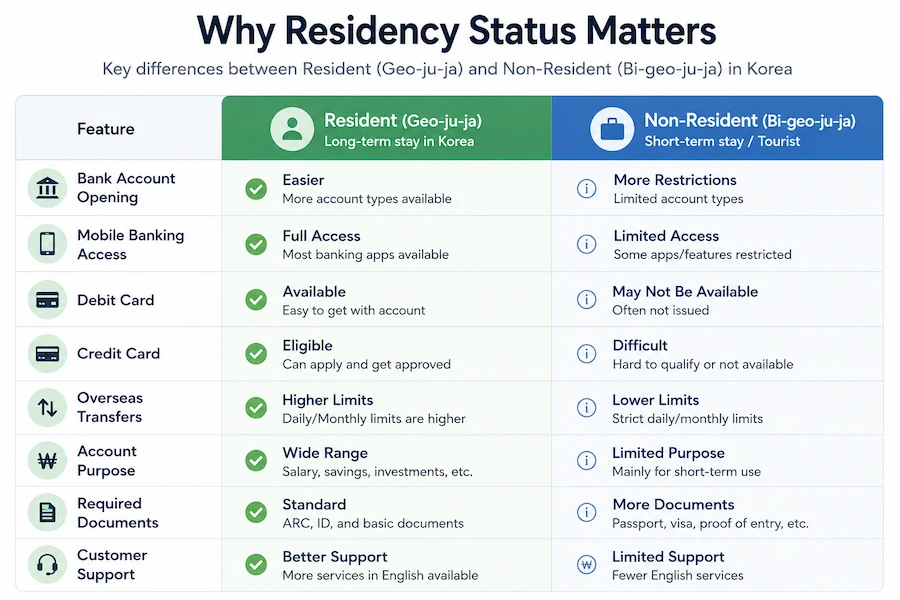
Banking services and account features in Korea can vary significantly depending on whether you are classified as a resident or a non-resident.
For many foreigners, obtaining resident status can make everyday financial life in Korea much easier by providing broader access to banking services, higher transfer limits, and fewer restrictions.
By contrast, non-residents often face additional paperwork, stricter verification requirements, and limited access to certain banking services.
🏦 What Happens When a Tourist Walks Into a Korean Bank?
Imagine you’ve just arrived in Seoul and walk into a major bank branch, such as Shinhan Bank, Hana Bank, or KB Kookmin Bank.
You approach the counter and say:
“I’d like to open a Korean bank account.”
What happens next?
In many cases, the first question you’ll hear is:
“Do you have an ARC?”
If the answer is no, your banking options may become much more limited.
Unlike long-term residents, tourists and other non-residents usually cannot open an account entirely online or access the full range of banking services.
📋 What Non-Residents Can Expect at a Korean Bank
| Step | What Usually Happens |
|---|---|
| 🪪 Identity Check | The bank verifies your passport and immigration status. |
| 🏦 Branch Visit Required | Most non-residents must visit a branch in person. |
| 📄 Document Review | Additional documents may be requested depending on the bank. |
| 🔍 Compliance Checks | Banks may conduct extra verification procedures. |
| ⚠️ Account Restrictions | Some account features may be limited or unavailable. |
⚠️ Possible Restrictions for Non-Resident Accounts
Even if your application is approved, the account may come with certain limitations.
| Service | Possible Restriction |
|---|---|
| 💸 Money Transfers | Lower daily or monthly transfer limits |
| 🏧 ATM Withdrawals | Reduced withdrawal limits |
| 💳 Debit Card Usage | Some features may be restricted |
| 📱 Mobile Banking | Limited access or additional verification required |
| 🌍 International Transfers | Additional documentation may be needed |
| 🏦 Account Type | Only certain account types may be available |
The exact restrictions vary by bank, branch, and your individual circumstances.
Many of these limitations are designed to comply with regulations related to fraud prevention and anti-money laundering requirements.
For short-term visitors and tourists, removing these restrictions can be difficult without obtaining long-term residency status in Korea.
📋 The Ultimate Paperwork Checklist
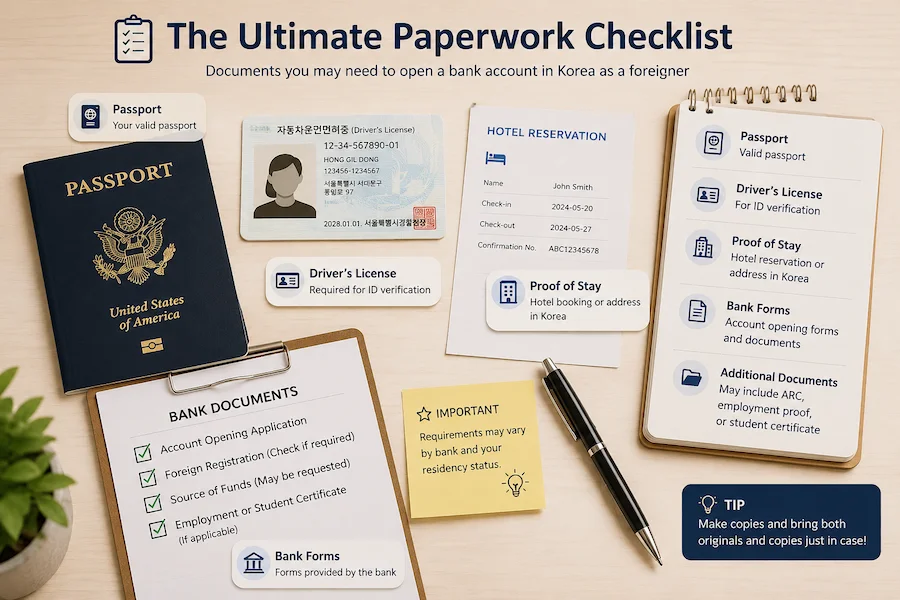
f you’re planning to apply for a Korean bank account as a non-resident, preparation is essential.
In many cases, showing up with only your passport isn’t enough. Banks may request additional documents depending on your visa status, the type of account you’re opening, and the reason you need the account.
📑 Documents You May Need
| Document | Examples | Why It May Be Required |
|---|---|---|
| 🛂 Passport | Valid physical passport | Identity verification |
| 🪪 Secondary Identification | Driver’s license, national ID card, government-issued ID | Additional identity checks |
| 🏠 Proof of Overseas Address | Utility bill, bank statement, government document | Verification of your home address |
| 🏨 Proof of Stay in Korea | Hotel reservation, Airbnb confirmation, lease agreement | Confirmation of your local address in Korea |
| 📄 Proof of Purpose | Property transaction, business activity, investment documents, medical records | To explain why you need the account |
⚠️ Important Notes
For most documents, banks prefer to see:
✔ Original documents rather than digital copies
✔ Your full name clearly displayed
✔ A current and valid address
✔ Supporting documents in English or Korean whenever possible
Requirements can vary significantly depending on the bank and even the individual branch.
For this reason, it’s often a good idea to call the bank in advance or bring more documents than you think you’ll need.
💡 Pro Tip
One of the most common reasons applications are delayed is because applicants cannot clearly explain why they need the account.
Simply saying that you want a Korean bank account “for convenience” may not be enough.
Providing supporting documents related to your business activities, investments, medical treatment, or other legitimate purposes can significantly improve your chances of a smoother application process.nough.
📱 Can Non-Residents Use Korean Banking Apps?
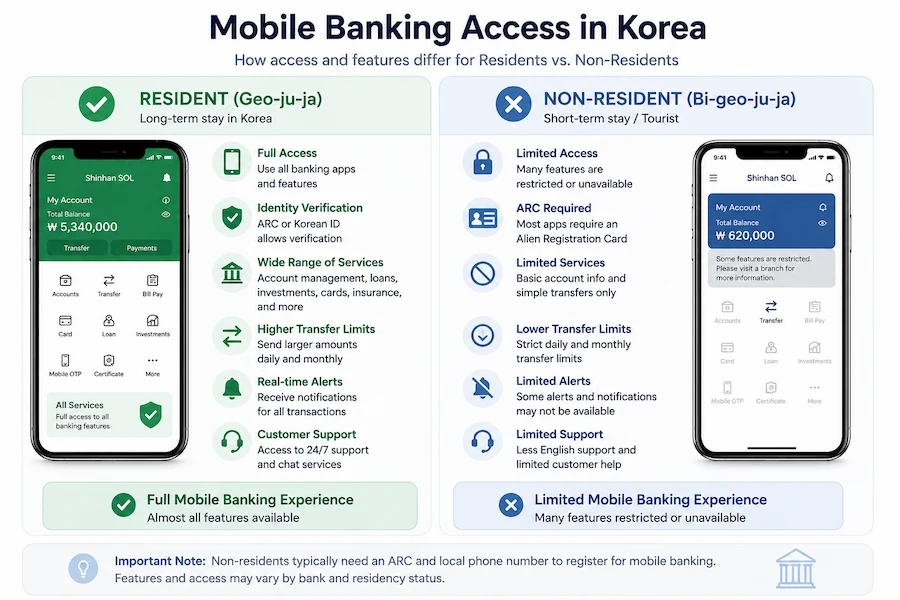
This is one of the most common questions among foreign visitors and new arrivals in Korea.
The short answer is:
Usually not, or at least not with full functionality.
Most Korean banking apps rely heavily on identity verification linked to Korean residency records, which makes mobile banking significantly easier for residents than for non-residents.
Popular banking apps such as:
✔ Toss
✔ KakaoBank
✔ K Bank
typically require resident-level identity verification connected to Korean government databases.
Without an Alien Registration Card (ARC) and, in many cases, a Korean phone number, many non-residents cannot complete the verification process.
📊 Mobile Banking Access at a Glance
| Feature | 👤 Resident | ✈️ Non-Resident |
|---|---|---|
| Mobile Banking Registration | ✅ Usually Available | ❌ Often Restricted |
| Identity Verification | ✅ ARC or Korean ID | ⚠️ Additional Requirements |
| Banking App Features | ✅ Full Access | ⚠️ Limited Features |
| Transfer Limits | ✅ Higher Limits | ⚠️ Lower Limits |
| Real-Time Alerts | ✅ Available | ❌ May Be Limited |
| Customer Support | ✅ Full Support | ⚠️ Limited Services |
🔒 Why Is Verification So Strict?
Korea’s digital banking system is designed to prevent:
✔ Fraud
✔ Identity theft
✔ Money laundering
✔ Other financial crimes
Because of these regulations, banks must verify a customer’s identity before granting access to many digital banking services.
As a result, mobile banking is generally much easier for residents than for non-residents.
💡 Good News for Long-Term Residents
Once you obtain an ARC and complete the bank’s identity verification process, you’ll usually gain access to:
✔ Mobile banking apps
✔ Internet banking
✔ Real-time transfer notifications
✔ Online payments and digital services
✔ A much wider range of banking features
For many foreigners, receiving an ARC is the moment when everyday banking in Korea becomes significantly more convenient.
🏦 Which Korean Bank Is Most Foreigner-Friendly?
Not all Korean bank branches have the same level of experience when it comes to serving international customers.
Some branches regularly assist foreigners, while others may rarely handle non-resident applications. Choosing the right bank—and the right branch—can make the account-opening process much smoother.
📊 Quick Comparison of Foreigner-Friendly Banks
| Bank | English Support | Best For |
|---|---|---|
| 🏦 Shinhan Bank | ⭐⭐⭐⭐⭐ Excellent | Tourists, expats, international customers |
| 🏦 Hana Bank | ⭐⭐⭐⭐⭐ Excellent | Students, expats, overseas transfers |
| 🏦 KB Kookmin Bank | ⭐⭐⭐⭐ Good | General banking and nationwide coverage |
| 🏦 Woori Bank | ⭐⭐⭐⭐ Good | Foreign workers and students |
⭐ Why These Banks Are Popular with Foreigners
| Bank | Highlights |
|---|---|
| 🏦 Shinhan Bank | Known for English-speaking staff and extensive experience assisting foreign customers. |
| 🏦 Hana Bank | Popular among international students and expats, with strong overseas remittance services. |
| 🏦 KB Kookmin Bank | Korea’s largest bank by branch network, making it convenient throughout the country. |
| 🏦 Woori Bank | Frequently used by foreign workers and students for everyday banking needs. |
🌏 Choose the Right Branch
When possible, avoid small neighborhood branches that may have limited experience with international customers.
Instead, consider visiting branches in:
📍 Myeongdong
📍 Itaewon
📍 Gangnam
📍 Hongdae
📍 Major university districts
These locations are generally more familiar with foreign customers, residency requirements, and non-resident applications.
💡 Practical Tips Before Visiting a Bank
| Tip | Why It Helps |
|---|---|
| 📄 Bring Extra Documents | Additional paperwork can prevent delays or a second visit. |
| 🖨️ Bring Printed Copies | Some branches prefer physical documents over digital copies. |
| ⏰ Visit Earlier in the Day | Foreign account applications often take longer than regular transactions. |
| 😊 Be Patient and Flexible | Different branches may apply procedures differently. |
| 🌏 Choose Foreigner-Friendly Branches | Staff are usually more experienced with foreign customers. |
💡 Pro Tip
If you’re visiting Korea for only a short period, consider whether you actually need a Korean bank account.
In many cases, services such as WOWPASS, NAMANE, or an international credit card may be faster and more convenient than opening a local bank account.
🚨 Before Opening a Korean Bank Account
Before trying to open a Korean bank account, there are two important things every foreign visitor should know.
⚠️ Avoid Bank Account Brokers
While researching Korean banking, you may come across individuals or online advertisements claiming they can open a Korean bank account on your behalf.
Common promises include:
❌ Guaranteed account approval
❌ Fast account opening
❌ No paperwork required
❌ Special access for foreigners
Although these offers may sound convenient, they should be treated as major warning signs.
Korean banks are required to verify a customer’s identity and review supporting documents before opening an account. Legitimate banks do not bypass these procedures.
Using another person’s identity or allowing someone else to open an account in your name can lead to serious problems, including:
❌ Account restrictions or suspension
❌ Additional identity verification requests
❌ Financial compliance investigations
❌ Immigration-related complications
💡 Safe Banking Tip
If you need a Korean bank account, always visit an official bank branch and complete the application yourself. It may take a little longer, but it is by far the safest and most reliable option.
💳 Do You Actually Need a Korean Bank Account?
Surprisingly, many short-term visitors don’t need a Korean bank account at all.
If your goal is simply to:
🍜 Eat at restaurants
🛍️ Shop
🚇 Use public transportation
✈️ Travel around Korea
then opening a local bank account may be unnecessary.
📊 Alternatives to a Korean Bank Account
| Service | Suitable for Short-Term Visitors? |
|---|---|
| 💳 International Credit Cards | ✅ Yes |
| 💳 International Debit Cards | ✅ Yes |
| 🌏 WOWPASS | ✅ Yes |
| 🌏 NAMANE Card | ✅ Yes |
| 🏦 Korean Bank Account | ❌ Usually Not Necessary |
These options are often faster, simpler, and more convenient than navigating Korea’s banking system as a non-resident.
👤 Who Actually Needs a Korean Bank Account?
Opening a Korean bank account becomes much more useful if you:
✔ Work in Korea
✔ Study in Korea
✔ Receive income in Korea
✔ Stay in Korea long-term
✔ Need regular domestic transfers
✔ Frequently use Korean financial services
For these individuals, a local bank account can make everyday life in Korea significantly easier and more convenient.
❓ Frequently Asked Questions
Q.Can I open a Korean bank account without an ARC?
Sometimes. Approval depends on the bank, your documents, and the reason you need the account.
Q.Do tourists need a Korean bank account?
Usually not. Most short-term visitors can easily get by using international cards, WOWPASS, or NAMANE.
Q.Can non-residents use Korean banking apps?
Limited access is common. Most banking apps require ARC-based identity verification to unlock full features.
Q.Which Korean bank is the most foreigner-friendly?
Many foreigners recommend Shinhan Bank and Hana Bank, especially branches in areas like Myeongdong, Itaewon, and Gangnam.
Q.Can I open a Korean bank account online?
Generally no. Most non-residents must visit a branch in person and complete identity verification.
Q.Should I use someone who offers to open an account for me?
No. Avoid account brokers or anyone promising “guaranteed approval” or “no paperwork.” Always apply directly through an official bank branch.
🎯 Final Thoughts
When it comes to banking in Korea, your residency status matters far more than your nationality.
Residents generally enjoy easier access to banking services, while non-residents should expect more restrictions and additional verification requirements.
Before visiting a bank, take a moment to understand how you’re likely to be classified.
And if you’re only visiting Korea for a short trip, remember that you may not need a Korean bank account at all. Services like international cards, WOWPASS, and NAMANE are often more than enough for everyday spending.
With the right expectations, navigating Korea’s banking system can be much simpler than it seems.
📚 Related Korea Living Guides
Planning a longer stay in Korea? These guides may help:
How to Open a Bank Account in Korea as a Foreigner
Toss Bank Account for Foreigners
How to Get a Korea ARC (Residence Card): Complete Guide